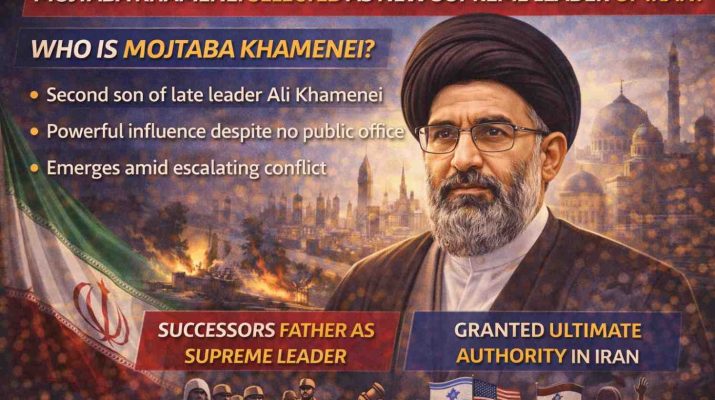
Reports from international media indicate that Mojtaba Khamenei has been selected as the new Supreme Leader of Iran, marking a historic leadership shift in the country during one of the most intense geopolitical crises in the region.
The development follows the death of longtime leader Ali Khamenei amid ongoing military conflict involving Iran, Israel, and the United States. Iran’s powerful clerical body responsible for appointing the country’s top authority reportedly voted to elevate Mojtaba Khamenei as the third Supreme Leader of the Islamic Republic, signaling continuity within the country’s hardline political structure. (The Japan Times)
The leadership transition has drawn global attention, particularly because it occurs during escalating regional tensions and raises questions about the future direction of Iranian policy.
How Iran Selects Its Supreme Leader
Iran’s Supreme Leader is the highest authority in the country’s political and religious system. The leader holds ultimate control over the military, judiciary, and major policy decisions.
The position is filled by the Assembly of Experts, an 88-member clerical body tasked with selecting and supervising the Supreme Leader. (The Japan Times)
Following the death of Ali Khamenei, the assembly reportedly convened to determine his successor. Mojtaba Khamenei’s appointment represents a rare case of leadership passing from father to son, which has sparked debate because the Islamic Republic was originally founded in opposition to hereditary political power.
Who Is Mojtaba Khamenei?
Mojtaba Khamenei, believed to be in his mid-50s, is the second son of Ali Khamenei and has long been considered an influential figure within Iran’s political and religious establishment.
Although he rarely appeared in public political roles, analysts have often described him as a powerful behind-the-scenes operator in Iran’s leadership structure. He studied Islamic jurisprudence in the holy city of Qom and developed strong ties with senior clerics and security officials. (aljazeerah.info)
Unlike many prominent Iranian politicians, Mojtaba has never held elected office, but his influence reportedly grew through connections with key institutions, including the country’s powerful security establishment. (aljazeerah.info)
Over the years, he has been associated with conservative factions within Iran’s political system and has been viewed by many analysts as a potential successor to his father.
A Leader Emerging During War
Mojtaba Khamenei’s reported appointment comes at a time when Iran is deeply involved in a widening regional conflict.
Military strikes and retaliatory attacks between Iran and Israel, with involvement from the United States, have dramatically increased tensions across the Middle East. The leadership change adds another layer of uncertainty as the new leader assumes power in the middle of a major geopolitical crisis.
Analysts say the transition may strengthen the role of security institutions within Iran’s political system, particularly the Islamic Revolutionary Guard Corps, which is believed to hold significant influence within the country’s power structure.
Why the Succession Is Controversial
The potential elevation of Mojtaba Khamenei has sparked debate both inside and outside Iran.
One key reason is the perception that the succession resembles a dynastic transition, something critics say contradicts the principles of the Islamic Republic, which replaced Iran’s monarchy in 1979.
Observers have also noted that Mojtaba does not possess the same level of public religious authority as previous supreme leaders. His father served as leader for more than three decades and was considered one of the most powerful figures in the region.
Supporters within Iran’s political establishment, however, argue that Mojtaba has extensive experience within the system and strong connections with the country’s institutions.
Global Reactions to the Leadership Change
International reaction to the leadership shift has been cautious and closely tied to ongoing regional tensions.
U.S. President Donald Trump reportedly expressed disappointment over Mojtaba Khamenei’s appointment, suggesting the move would likely continue existing tensions between Washington and Tehran. (Reuters)
Analysts also note that Israel and other regional actors will be closely monitoring how the new leadership shapes Iran’s military and diplomatic strategy.
The appointment could influence Iran’s approach to negotiations, regional alliances, and ongoing conflicts in the Middle East.
What Mojtaba Khamenei’s Leadership Could Mean
With Mojtaba Khamenei reportedly taking the country’s highest office, several key questions now dominate geopolitical discussions.
First, analysts are watching whether the new leader will maintain the same strategic posture toward Western powers as his father. Iran’s relationship with the United States and Israel has been defined by decades of hostility and geopolitical rivalry.
Second, there is speculation about how Mojtaba might manage internal political dynamics within Iran, particularly among clerical leaders, security institutions, and reformist political groups.
Finally, the leadership transition occurs during a period of intense regional instability, meaning decisions taken by the new leader could significantly shape the future of Middle Eastern geopolitics.
A Historic Turning Point for Iran
The reported selection of Mojtaba Khamenei marks one of the most consequential leadership transitions in Iran since the death of Ayatollah Ruhollah Khomeini in 1989.
If confirmed, his rise would represent the first father-to-son succession in the Islamic Republic’s history, reflecting the powerful influence of Iran’s entrenched political and religious institutions.
As the country navigates war, economic pressure, and global scrutiny, Mojtaba Khamenei’s leadership will likely play a central role in determining Iran’s political trajectory and its position in an increasingly volatile Middle East.
Last Updated on: Saturday, March 14, 2026 12:06 am by The Weekly News Team | Published by: The Weekly News Team on Tuesday, March 10, 2026 10:41 pm | News Categories: Politics
About The Author

