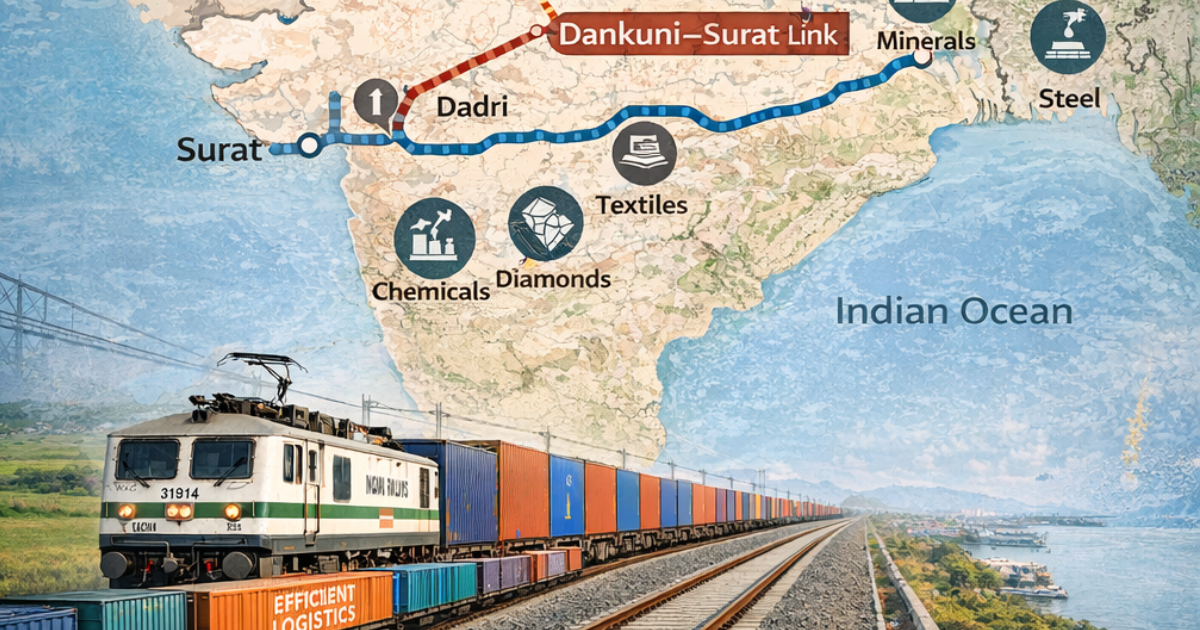
The proposed Dankuni–Surat Dedicated Freight Corridor link aims to streamline east–west freight movement and significantly cut logistics costs for Indian businesses.
India’s ambitious Dedicated Freight Corridor programme is entering a decisive phase with renewed focus on the eastern–western industrial spine. Among the most closely watched segments is the proposed Dankuni–Surat freight link, a rail corridor designed to directly connect eastern India’s industrial clusters with the manufacturing and export hubs of western India. As logistics costs continue to be a major concern for businesses, policymakers and industry leaders see this corridor as a game-changing infrastructure upgrade that could significantly improve efficiency, reliability, and competitiveness.
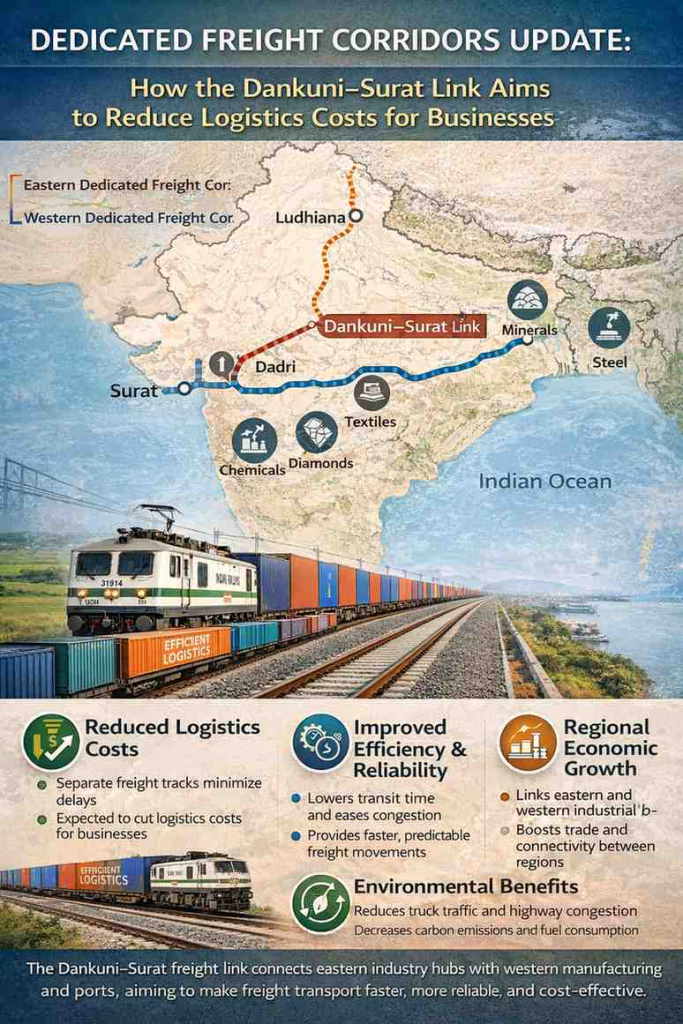
The Dankuni–Surat link is not merely another rail project. It is being positioned as a strategic connector between the Eastern Dedicated Freight Corridor, which originates near Ludhiana and terminates at Dankuni in West Bengal, and the Western Dedicated Freight Corridor that runs from Dadri near Delhi to the ports of Gujarat. By bridging these two major arteries, the corridor aims to create a seamless freight movement system across the country.
Why Logistics Costs Matter for Indian Businesses
Logistics costs in India have historically hovered between 13 and 14 percent of GDP, significantly higher than global benchmarks in developed economies. For manufacturers, exporters, and even domestic traders, these costs translate into thinner margins and reduced price competitiveness. Delays, congestion, and dependence on mixed-traffic railway lines have long undermined supply chain reliability.
The Dankuni–Surat freight link directly addresses these challenges by providing a high-capacity, dedicated route for goods trains. By separating freight movement from passenger traffic, the corridor is expected to enable longer trains, higher axle loads, and predictable transit schedules. For businesses, this means faster turnaround times and lower inventory holding costs, both of which directly affect profitability.
Connecting Industrial Belts Across Regions
Dankuni, located near Kolkata, is a key logistics node for eastern India, serving industries in West Bengal, Odisha, Jharkhand, and Bihar. These regions are rich in minerals, steel production, cement manufacturing, and emerging industrial parks. Surat, on the other hand, is a major hub for textiles, diamonds, chemicals, and petrochemicals, with close proximity to key ports such as Hazira and Mundra.
The direct rail connectivity between these two nodes is expected to unlock new trade flows. Raw materials from eastern India can move more efficiently to western manufacturing centers, while finished goods and exports can reach ports faster. This east-west integration is particularly important as India seeks to rebalance industrial growth beyond traditional regional silos.
Reducing Transit Time and Improving Reliability
One of the major promises of the Dankuni–Surat corridor is a substantial reduction in transit time. Freight trains on existing routes often face delays due to congestion and priority given to passenger services. Dedicated freight tracks, designed for higher speeds and uninterrupted movement, are expected to cut journey times by nearly half on certain stretches.
Reliability is equally important. Businesses increasingly operate on just-in-time production models, where delays in raw material supply or outbound shipments can disrupt entire production cycles. The corridor’s advanced signaling systems, centralized traffic control, and standardized operating protocols aim to provide consistent and predictable freight services, a long-standing demand of industry associations.
Impact on Small and Medium Enterprises
While large corporations often dominate discussions around logistics infrastructure, the Dankuni–Surat link could have a meaningful impact on small and medium enterprises as well. SMEs frequently rely on road transport due to unreliable rail freight schedules, despite higher fuel and toll costs. With improved rail connectivity, smaller businesses may find it economically viable to shift bulk and long-distance shipments to rail.
Lower logistics costs can also enable SMEs to access new markets. Manufacturers in eastern India, for example, could expand their customer base in western and southern states without facing prohibitive transportation expenses. Over time, this could encourage greater regional integration and more balanced economic development.
Environmental and Energy Efficiency Gains
Beyond cost and efficiency, the corridor also carries environmental significance. Rail transport is substantially more energy-efficient and less carbon-intensive than road transport, particularly for bulk freight. As businesses increasingly face pressure to reduce their carbon footprint, the availability of reliable rail freight options becomes a strategic advantage.
The Dankuni–Surat link is expected to reduce the number of long-haul trucks on highways, easing congestion and lowering emissions. For companies with sustainability commitments, shifting freight to rail could help meet environmental targets while also delivering financial savings.
Challenges and the Road Ahead
Despite its potential, the project faces challenges typical of large-scale infrastructure development. Land acquisition, coordination across multiple states, and alignment with existing railway networks require careful planning and sustained political commitment. Industry stakeholders are also watching closely to see how pricing, service quality, and last-mile connectivity will be managed once the corridor becomes operational.
The success of the Dankuni–Surat link will ultimately depend on how well it integrates with industrial parks, logistics hubs, and ports. Investments in multimodal terminals and digital freight management systems will be crucial to ensure that the benefits of the corridor are fully realized.
A Turning Point for India’s Freight Movement
As India positions itself as a global manufacturing and export hub, efficient logistics infrastructure is no longer optional. The Dankuni–Surat Dedicated Freight Corridor link represents a decisive step toward modernizing the country’s freight movement ecosystem. For businesses, the promise lies not just in faster trains, but in a more reliable, cost-effective, and competitive supply chain.
If executed as planned, the corridor could mark a turning point in how goods move across India, helping reduce logistics costs, strengthen regional industrial linkages, and support long-term economic growth.
Add theweeklynews.in as a preferred source on google – click here
Last Updated on: Tuesday, February 3, 2026 12:06 pm by The Weekly News Team | Published by: The Weekly News Team on Tuesday, February 3, 2026 12:06 pm | News Categories: Business
About The Author