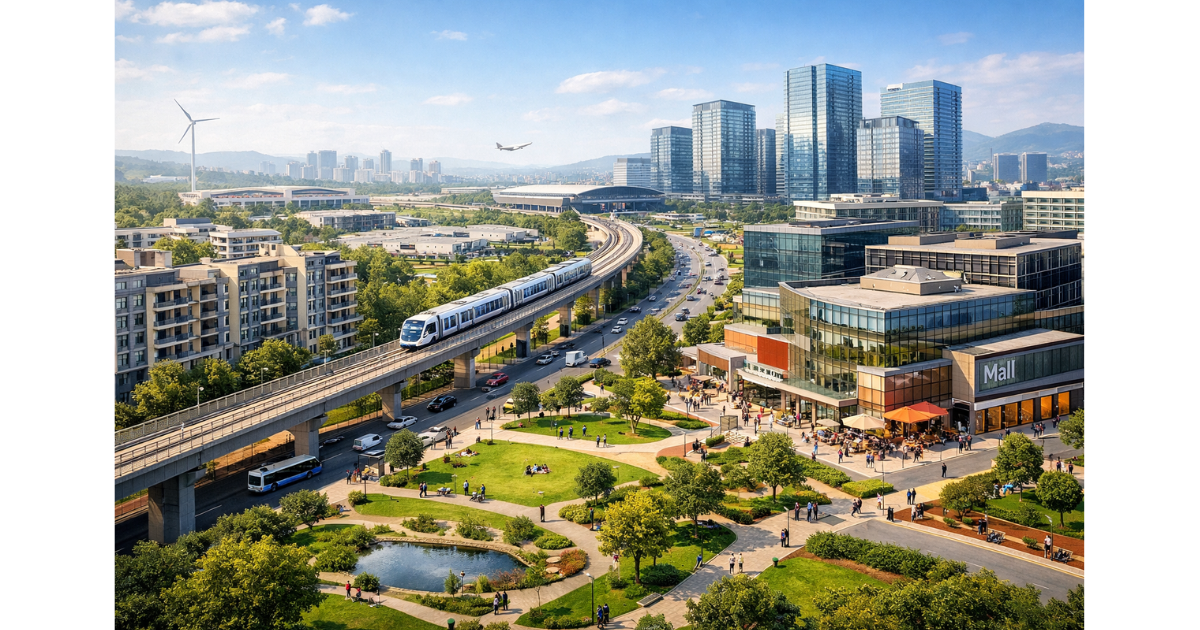
India’s Tier 2 cities are emerging as growth engines as smart city projects and economic region clusters reshape real estate markets and create new employment hubs beyond metros.
India’s urban story is entering a decisive new phase, one that moves beyond the familiar metros and places Tier 2 cities at the centre of economic transformation. The government’s renewed push toward smart cities, combined with the creation of new economic region clusters, is reshaping how and where growth happens. This shift is already altering real estate markets and redefining employment opportunities, with implications that will be felt by households, businesses, and investors over the next decade.
Why Tier 2 Cities Are Moving Into the Spotlight
For years, India’s development narrative revolved around a handful of megacities that absorbed talent, capital, and infrastructure spending. While these cities powered economic expansion, they also became symbols of congestion, high living costs, and unequal access to opportunity. Policymakers have increasingly acknowledged that sustainable growth requires a wider urban base. Smart city initiatives and economic region clustering are designed to distribute development more evenly, allowing Tier 2 cities to emerge as engines of productivity rather than satellites of metros.
Understanding the Idea of Economic Region Clusters
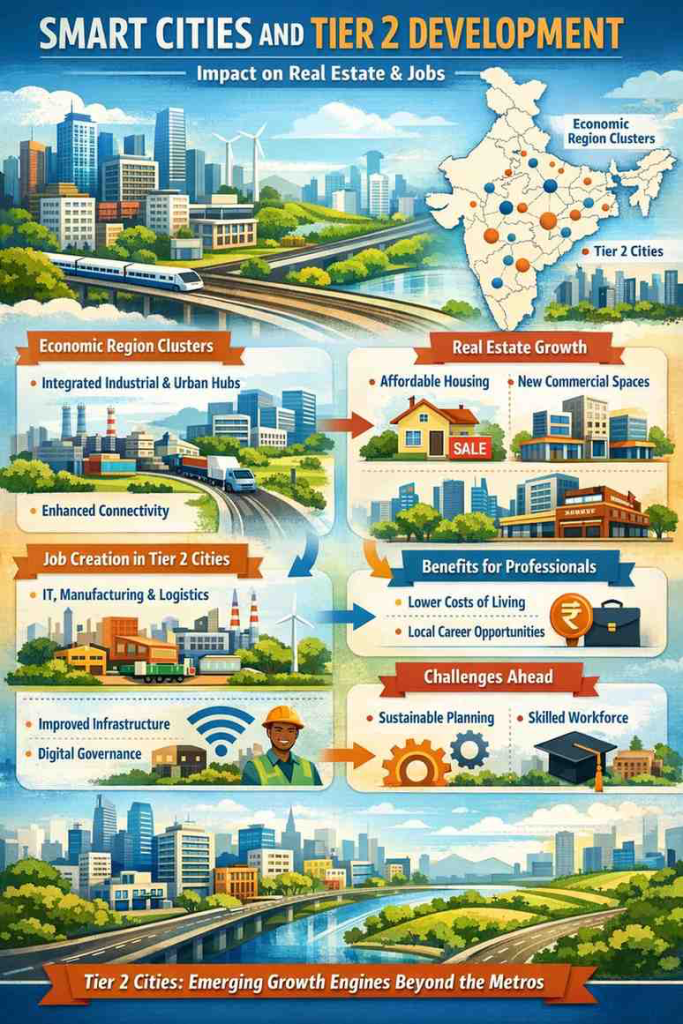
Economic region clusters are not merely administrative groupings of districts. They are planned ecosystems that link cities with surrounding industrial corridors, logistics hubs, educational institutions, and digital infrastructure. By focusing on connectivity, governance reforms, and sector-specific strengths, these clusters aim to create self-sustaining regional economies. When aligned with smart city frameworks that prioritise technology-driven governance, efficient utilities, and liveable urban design, Tier 2 cities gain a competitive edge that was once reserved for larger urban centres.
Real Estate Markets Begin to Reflect the Shift
The impact on real estate is already visible. Residential demand in many Tier 2 cities has shifted from purely end-user driven housing to a mix that includes investors, developers, and institutional players. Improved road networks, new rail links, and upgraded airports within these clusters have reduced travel time to metros and ports, making these cities more attractive for both living and business operations. As a result, land values on the outskirts of Tier 2 cities, particularly near industrial parks and transit corridors, have seen steady appreciation.
From Speculation to Fundamentals in Housing Demand
Unlike earlier real estate booms driven by speculation, the current trend is closely tied to economic fundamentals. Developers are increasingly aligning projects with employment zones, offering integrated townships that combine housing, offices, retail, and social infrastructure. Demand is strong for mid-income and affordable housing, reflecting the influx of young professionals and skilled workers who prefer cities with lower costs and better quality of life.
Commercial and Retail Spaces Find New Anchors
Commercial real estate is also evolving, with flexible office spaces, technology parks, and data centres finding a natural home in these emerging clusters. Retail and mixed-use developments are benefiting as well. As disposable incomes rise in Tier 2 cities, consumer behaviour is changing, creating demand for organised retail, entertainment, and hospitality. This has a multiplier effect on local economies, supporting small businesses while attracting national and global brands.
Job Creation Beyond the Metros
Job creation is the second, and perhaps more transformative, outcome of the new economic region cluster strategy. By decentralising industrial and service sector growth, these clusters are generating employment closer to where people live. Manufacturing units, logistics companies, IT services firms, and emerging sectors such as electronics, renewable energy, and food processing are expanding operations in Tier 2 regions. This diversification reduces overdependence on a single sector and enhances resilience during economic downturns.
How Smart City Investments Support Employment
Smart city investments further amplify employment potential by improving the ease of doing business. Digital land records, single-window clearances, and smart utilities lower operational friction for companies. This encourages startups and small enterprises to set up locally rather than migrating to metros. The presence of universities, skilling centres, and innovation hubs within these clusters also helps align workforce capabilities with industry needs, reducing the skills mismatch that has long plagued regional labour markets.
What This Means for Professionals and Local Communities
For the workforce, the implications are significant. Professionals who once felt compelled to relocate to metros now have viable career options closer to their hometowns. Lower living costs, shorter commutes, and better urban services contribute to improved work-life balance. At the same time, local populations gain access to higher-quality jobs, reducing distress migration and supporting more inclusive growth.
Challenges That Will Shape the Outcome
However, the transition is not without challenges. Rapid urban expansion can strain local governance if planning and execution do not keep pace with growth. Real estate development must be balanced with environmental considerations, water management, and affordable housing to avoid repeating the mistakes of larger cities. Ensuring that job creation benefits local communities, rather than bypassing them, will require sustained investment in education and skill development.
The Road Ahead for India’s Emerging Urban Regions
Despite these risks, the broader direction is clear. Smart cities and Tier 2 economic region clusters represent a strategic reimagining of India’s urban future. By linking infrastructure, real estate, and employment within a regional framework, the model seeks to create cities that are productive yet liveable, competitive yet inclusive. For real estate markets, this means steadier growth grounded in genuine demand. For jobs, it signals a more balanced geography of opportunity. And for India’s economy as a whole, it marks a shift toward development that is not concentrated in a few crowded centres, but spread across a network of emerging urban regions poised to define the next chapter of growth.
Add theweeklynews.in as a preferred source on google – click here
Last Updated on: Wednesday, February 4, 2026 6:27 pm by The Weekly News Team | Published by: The Weekly News Team on Wednesday, February 4, 2026 12:31 pm | News Categories: News
About The Author