Government exam aspirants gear up for 2026 as current affairs and new policy changes take center stage in competitive examinations
The year 2026 is shaping up to be a defining phase for millions of government job aspirants across India. With large-scale recruitment expected across central and state government departments, public sector undertakings, and constitutional bodies, the competitive exam ecosystem is witnessing notable shifts. Alongside the release of exam calendars and vacancy projections, aspirants must now adapt to evolving exam patterns, deeper emphasis on current affairs, and several policy-level changes influencing recruitment rules.
For candidates preparing for examinations such as UPSC Civil Services, SSC CGL, Banking exams, Railways, Defence services, Teaching eligibility tests, and State Public Service Commissions, 2026 demands strategic preparation that goes beyond traditional syllabus coverage.
Rising Importance of Current Affairs in 2026 Examinations
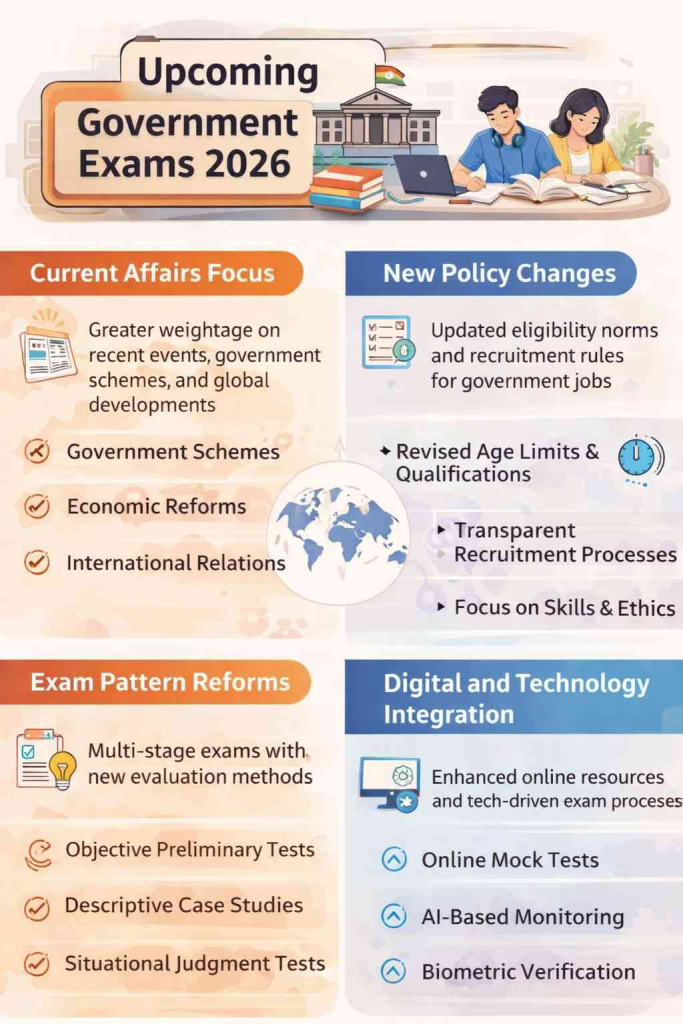
One of the most significant trends visible across upcoming government exams is the heightened weightage given to current affairs. Examining bodies are increasingly moving away from rote-based static questions and focusing on analytical understanding of recent national and international developments. Topics related to government schemes, economic reforms, digital governance, international relations, climate policies, science and technology innovations, and social justice initiatives are expected to dominate question papers.
Aspirants can no longer rely solely on last-minute monthly compilations. Instead, there is a growing expectation to connect current events with static subjects such as polity, economy, history, and geography. For example, questions on constitutional amendments are now often linked with recent Supreme Court judgments or parliamentary debates, while economy-related sections reflect recent budget announcements, monetary policy decisions, and global economic trends.
Policy Changes Influencing Recruitment and Eligibility
Several new policy changes introduced over the past year are expected to directly impact government examinations in 2026. Recruitment reforms focusing on transparency, faster selection processes, and technology-driven testing have become a priority for the government. Computer-based examinations, biometric verification, and centralized recruitment portals are being expanded to reduce delays and irregularities.
Another notable development is the increasing alignment of exam syllabi with real-world administrative and professional skills. For higher-level exams, especially Group A and B services, questions now test decision-making ability, ethical reasoning, and policy awareness rather than theoretical knowledge alone. Language proficiency, digital literacy, and awareness of national priorities such as sustainability, innovation, and inclusive development are also gaining prominence.
Eligibility norms in certain exams are undergoing review, particularly with regard to age limits, reservation policies, and educational qualifications. Aspirants are advised to regularly monitor official notifications, as even minor changes can significantly affect their application status.
Exam Pattern Reforms and Evaluation Methods
The structure of government exams in 2026 is expected to reflect a continued shift toward multi-stage assessment systems. Preliminary screenings are becoming more objective and elimination-focused, while main examinations and interviews emphasize depth, clarity of thought, and applied knowledge. Descriptive answers, case-study-based questions, and situational judgment tests are being used more frequently to assess candidates’ real-world readiness.
Negative marking schemes and normalization processes are also being fine-tuned to ensure fairness across multiple exam shifts. For aspirants, this means accuracy and conceptual clarity are more important than attempting a high number of questions.
Technology and Digital Platforms Reshaping Preparation
The role of technology in both exam administration and preparation has expanded rapidly. Government bodies are leveraging artificial intelligence for exam monitoring, result processing, and grievance redressal. At the same time, aspirants are increasingly dependent on digital resources such as online mock tests, e-learning platforms, government portals, and official digital repositories for authentic study material.
The integration of digital tools has also reduced the gap between urban and rural candidates, providing wider access to quality preparation resources. However, it has also raised the competition level, making consistent performance and smart study strategies essential.
What Aspirants Must Focus on Moving Forward
As government exams in 2026 approach, aspirants need to recalibrate their preparation plans. Regular tracking of current affairs, in-depth understanding of government policies, and familiarity with recent legal and economic developments are no longer optional. Equally important is staying updated with official exam notifications, syllabus revisions, and policy announcements from recruitment authorities.
Mental resilience, time management, and adaptability will play a decisive role in navigating the changing exam landscape. With recruitment becoming more streamlined but also more competitive, success will depend on informed preparation rather than sheer effort alone.
The Road Ahead for Government Job Seekers
The upcoming government exams of 2026 reflect a broader transformation in India’s recruitment system, one that aims to select candidates who are not just academically sound but also socially aware, technologically competent, and policy-oriented. For aspirants, this shift presents both challenges and opportunities.
Those who align their preparation with current affairs, understand policy implications, and adapt to new exam formats will be better positioned to succeed. As the countdown to 2026 continues, staying informed and preparation-ready remains the most powerful strategy for every serious government job aspirant.
Also read : Smart Cities And Tier 2 Development: How The New Economic Region Clusters Will Affect Real Estate And Jobs
Add theweeklynews.in as a preferred source on google – click here
Last Updated on: Thursday, February 5, 2026 11:42 am by The Weekly News Team | Published by: The Weekly News Team on Thursday, February 5, 2026 11:41 am | News Categories: News
About The Author