Controversy Over Judiciary Chapter Leads to NCERT Apology
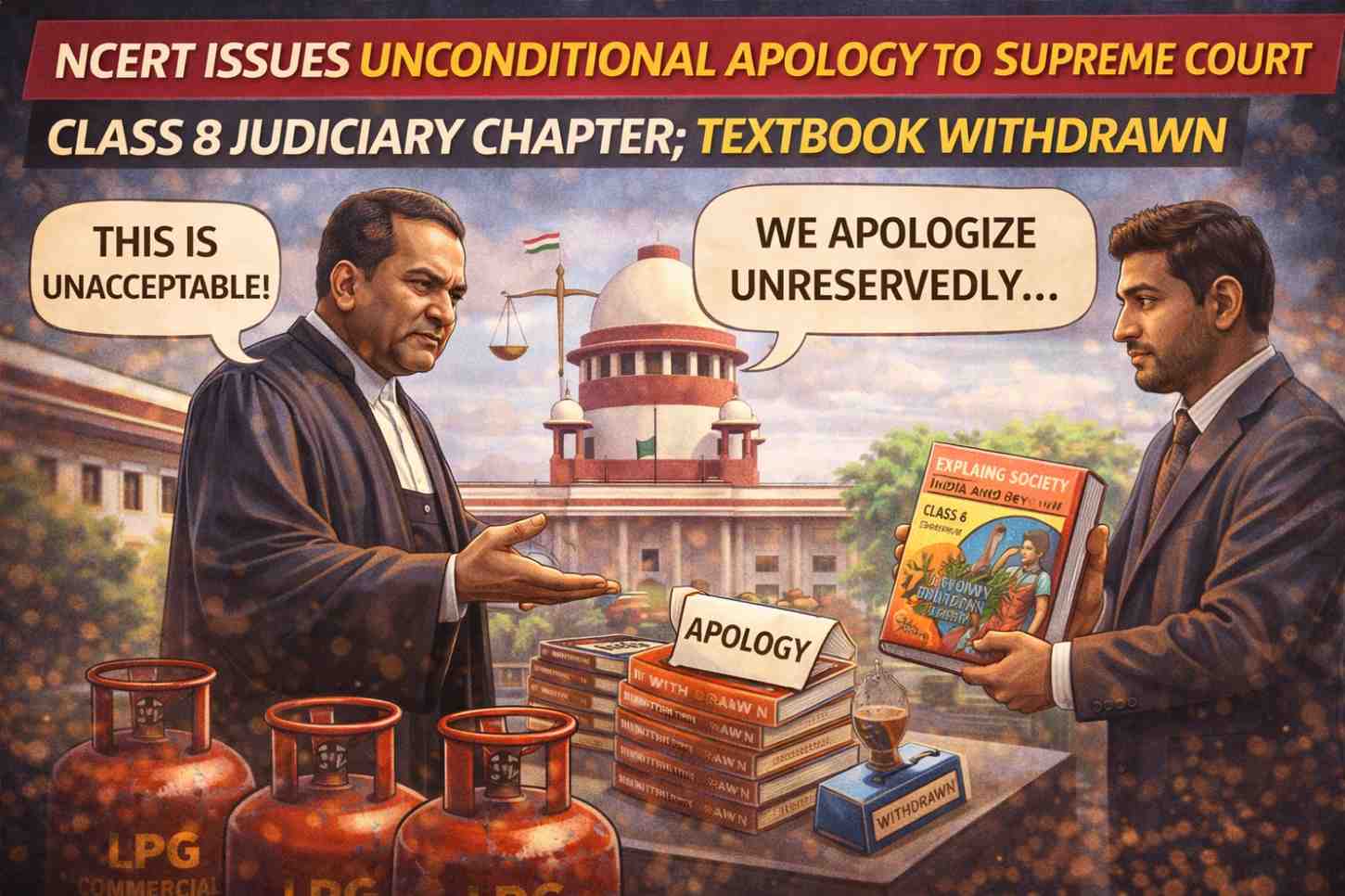
The National Council of Educational Research and Training (NCERT) has issued an “unconditional and unqualified apology” to the Supreme Court after a controversy erupted over a chapter in a newly released Class 8 social science textbook discussing issues within the judiciary. The education body has also withdrawn the entire textbook from circulation following strong objections from the apex court. (The Indian Express)
The book titled Exploring Society: India and Beyond – Social Science Grade 8 (Part II) contained a chapter titled “The Role of Judiciary in Our Society.” A section in the chapter referred to challenges such as corruption and delays within the judicial system, which drew sharp criticism from the Supreme Court. (The Indian Express)
The development has sparked a nationwide debate over how institutional issues should be discussed in school textbooks and the limits of criticism of constitutional bodies.
What NCERT Said in Its Public Apology
In an official statement, NCERT said that the Director and members of the council tender an unconditional apology for the controversial content and confirmed that the entire textbook has been withdrawn.
The council acknowledged the concerns raised and emphasised that it remains committed to maintaining the highest standards of accuracy and sensitivity in educational material. (Moneycontrol)
NCERT also urged individuals and institutions in possession of the book to return copies to its publication division in New Delhi. In addition, any digital versions or excerpts of the disputed chapter circulating on social media or other platforms were requested to be removed. (Moneycontrol)
Officials said the content would be reviewed and rewritten in consultation with appropriate academic authorities before any future publication.
Supreme Court’s Strong Reaction to the Chapter
The controversy reached the Supreme Court after senior advocates raised concerns about the textbook’s content. A three-judge bench took suo motu cognisance of the issue and expressed strong displeasure with the references to judicial corruption. (The New Indian Express)
During the hearing, the Chief Justice stated that no one would be allowed to undermine or demean the dignity of the judiciary, indicating the seriousness with which the court viewed the issue. (The New Indian Express)
The court subsequently ordered a blanket ban on the publication, reprinting, and digital dissemination of the textbook, directing authorities to ensure that all copies were removed from circulation. (The Indian Express)
The bench also sought detailed information about the committee involved in drafting and approving the chapter, including the names and qualifications of its members.
What the Controversial Chapter Contained
The disputed section was part of the chapter explaining the role of the judiciary in India’s democratic system.
Along with describing the functions of courts, the chapter reportedly discussed challenges faced by the judicial system, including:
- Case backlogs across courts
- Shortage of judges
- Infrastructure constraints
- Concerns related to corruption affecting public confidence in the judiciary
These references were intended to explain systemic challenges but were criticised by the Supreme Court as inappropriate for a school-level textbook without sufficient context.
The court observed that the wording and presentation of such issues could potentially damage the credibility and integrity of the judicial institution, particularly when presented to young students.
Government Response and Accountability Measures
Following the controversy, the Union government indicated that accountability would be fixed for the lapse.
Union Education Minister Dharmendra Pradhan said the issue was being taken seriously and that action would be taken against those responsible for drafting or approving the contentious content.
Officials from the Ministry of Education also assured the court that corrective steps had been taken, including the immediate withdrawal of the book and a review of the textbook development process.
Textbook Withdrawal and Recall of Copies
The Class 8 textbook had been released only recently before the controversy emerged. Reports indicated that around 2.25 lakh copies had been printed, though only a small number had been sold before the court ordered its withdrawal.
NCERT began recalling available copies from distribution channels, including schools and retail outlets. Digital access to the book was also removed from official platforms.
The council said the chapter would be revised and republished only after proper review, ensuring that it reflects constitutional values and institutional respect.
Debate Over Teaching Institutional Challenges in Schools
The incident has triggered broader discussions in academic and legal circles about how school curricula should address institutional issues.
Some educators argue that textbooks should present a balanced and factual understanding of democratic institutions, including the challenges they face. Others believe that discussions about sensitive topics such as corruption must be handled carefully in school curricula to avoid misinterpretation.
The episode also highlights the complexities involved in writing civics textbooks in a democracy where institutions such as the judiciary play a crucial role in upholding constitutional values.
Previous Curriculum Debates Around NCERT
The judiciary chapter controversy is the latest in a series of debates surrounding changes in school textbooks.
Over the past few years, several NCERT revisions have sparked public discussions, including the removal or modification of certain historical references and political topics.
Such debates often revolve around questions of historical interpretation, political neutrality, and the role of education in shaping civic understanding.
What Happens Next
NCERT is expected to revise the disputed chapter and possibly reissue the textbook after consultations with subject experts and relevant authorities.
Meanwhile, the Supreme Court continues to monitor the matter and has asked for a compliance report regarding the withdrawal of the textbook and the steps taken to prevent similar issues in the future.
The controversy underscores the sensitive balance between academic discussion and institutional respect, especially when educational content is intended for young students learning about India’s constitutional framework.
Last Updated on: Friday, March 13, 2026 11:37 pm by The Weekly News Team | Published by: The Weekly News Team on Tuesday, March 10, 2026 10:30 pm | News Categories: India
About The Author