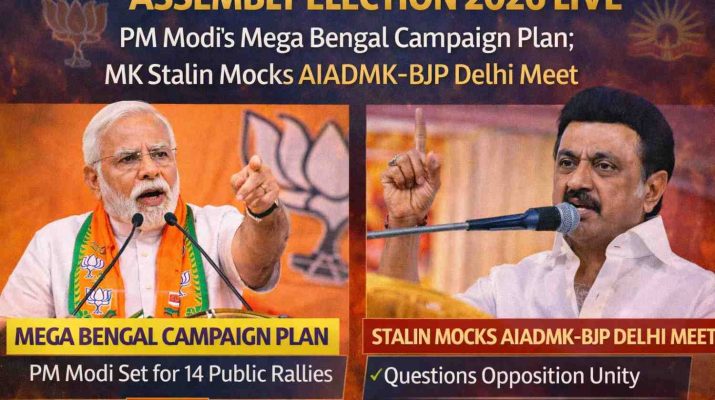
Campaigning for the Assembly Election 2026 has entered a high-intensity phase across key battleground states, with political heavyweights criss-crossing constituencies and sharpening their messaging. In West Bengal, Prime Minister Narendra Modi is set to lead an aggressive outreach programme reportedly featuring 14 public rallies, signalling the strategic importance the state holds for the ruling party.
Meanwhile in Tamil Nadu, Chief Minister M. K. Stalin has intensified his criticism of opposition leaders’ recent visits to New Delhi, framing them as politically motivated and disconnected from state-level issues. As campaigning gathers momentum, neighbouring Assam is also witnessing heightened activity from regional and national parties alike.
PM Modi’s Mega Campaign Push in Bengal
Political observers note that the Prime Minister’s packed rally schedule in West Bengal underscores the party’s determination to expand its electoral footprint in a state known for fiercely contested campaigns.
The planned rallies are expected to focus on themes such as development initiatives, central welfare schemes, infrastructure projects, and national security narratives — issues that have featured prominently in recent political messaging.
Party strategists believe that large-scale public meetings and roadshows remain crucial tools for energising grassroots workers and consolidating voter outreach ahead of polling.
High Stakes in a Polarised Political Landscape
West Bengal’s electoral terrain has historically been shaped by intense ideological competition and strong regional leadership. Analysts suggest that national leaders’ frequent visits signal an effort to recalibrate campaign dynamics in favour of broader narratives that resonate beyond local issues.
Political mobilisation has also intensified at the constituency level, with door-to-door campaigns, social media outreach, and targeted voter engagement programmes gaining prominence.
MK Stalin Targets Opposition Coordination
In Tamil Nadu, Chief Minister M. K. Stalin has publicly mocked opposition leaders’ consultations in New Delhi, suggesting that such meetings reflect internal uncertainty rather than cohesive electoral planning.
His remarks are seen as part of a broader strategy to reinforce the ruling alliance’s image as locally focused and administratively stable.
The political discourse in the state has centred around governance performance, welfare delivery, and regional identity — themes that often dominate Tamil Nadu’s electoral narratives.
AIADMK-BJP Engagement Draws Attention
Recent interactions between leaders of the All India Anna Dravida Munnetra Kazhagam (AIADMK) and the Bharatiya Janata Party (BJP) have sparked speculation about possible coordination or seat-sharing arrangements.
While official announcements remain limited, political analysts suggest that alliance arithmetic could play a decisive role in closely fought constituencies.
Opposition leaders have emphasised the need for strategic unity, particularly in states where vote fragmentation could influence outcomes.
Campaign Dynamics in Assam
In Assam, parties are focusing on regional development, employment opportunities, and cultural issues as they step up campaign intensity.
Rallies, candidate announcements, and manifesto promises have become daily highlights in the state’s political landscape. Observers note that voter turnout patterns and youth engagement will be key factors shaping results.
Digital Campaigning and Ground Mobilisation
The 2026 election cycle is witnessing a sophisticated blend of traditional and digital campaign strategies. Political parties are increasingly leveraging:
- Targeted social media messaging
- Real-time data analytics
- Influencer engagement
- Community-level outreach programmes
Experts say this hybrid approach reflects evolving voter behaviour, where online narratives can quickly influence ground-level perceptions.
Key Issues Dominating Election Discourse
Across West Bengal, Assam, and Tamil Nadu, several themes have emerged as central to campaign messaging:
✔ Welfare and Development
Parties are highlighting infrastructure projects, social schemes, and economic initiatives to appeal to diverse voter groups.
✔ Identity and Regional Aspirations
Cultural pride and state-specific concerns remain powerful mobilising factors.
✔ Governance Track Record
Incumbents are emphasising administrative achievements, while challengers focus on accountability and change.
✔ Youth Employment and Education
Young voters are being courted through promises of job creation and skill development.
Election Commission’s Role and Model Code Monitoring
As campaigning intensifies, authorities are also keeping a close watch on compliance with election regulations. Monitoring teams are tracking campaign expenditure, speech content, and logistical arrangements to ensure adherence to democratic norms.
Security deployments and voter awareness initiatives are being ramped up in sensitive constituencies to facilitate smooth polling.
Outlook: Final Phase Could Decide Momentum
With polling dates approaching, the final stretch of campaigning is likely to witness sharper rhetoric, high-profile roadshows, and intensified alliance negotiations.
Political strategists believe that momentum built during this phase can significantly influence voter sentiment, especially in tightly contested seats.
Conclusion
The Assembly Election 2026 blitz across West Bengal, Assam, and Tamil Nadu highlights the stakes involved for national and regional players alike. With Prime Minister Narendra Modi leading a high-octane campaign in Bengal and Chief Minister M. K. Stalin sharpening his attacks on opposition coordination, the political narrative is rapidly evolving.
As rallies multiply and alliances take shape, voters will ultimately determine how these strategies translate into electoral outcomes — making the coming weeks crucial for India’s dynamic democratic landscape. 🗳️🇮🇳
Last Updated on: Friday, March 20, 2026 11:54 pm by The Weekly News Team | Published by: The Weekly News Team on Friday, March 20, 2026 2:45 pm | News Categories: India, Politics
About The Author

