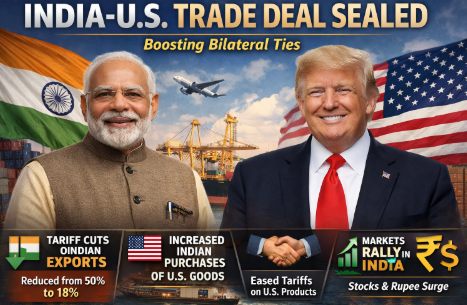
New Delhi / Washington, Feb 3, 2026 — After more than a year of intermittent negotiations, India and the United States have reached a landmark trade agreement that fundamentally reshapes economic ties between the world’s two largest democracies. The deal — announced by U.S. President Donald Trump following a phone call with Indian Prime Minister Narendra Modi — marks a dramatic de-escalation of trade tensions and opens new avenues for commerce, investment, and strategic cooperation.
Key Terms of the Agreement
At the heart of the deal are major tariff adjustments and trade-off requirements:
- Tariffs on Indian exports to the U.S. slashed from 50% to 18%. This includes removal of punitive duties that had previously elevated levies sharply, harming export competitiveness.
- Expanded Indian purchases of U.S. goods across key sectors — including petroleum, defence equipment, aerospace products, electronics, pharmaceutical and telecom products — are part of the broader commitment designed to address the U.S. trade imbalance with India.
- Reciprocal market access: India has agreed to cut tariffs on several U.S. products, reducing barriers on key industrial and agricultural goods, while Washington has signalled ongoing efforts to remove non-tariff obstacles for U.S. exporters.
Analysts describe the agreement as a “reset” in a relationship strained by trade friction since 2025, when U.S. tariff escalations had hit Indian exporters hard.
Political and Diplomatic Reactions
Prime Minister Narendra Modi, in his first reaction after the announcement, thanked President Trump and highlighted the deal’s importance for bilateral trust and economic cooperation.
Domestically, the deal has drawn mixed political commentary. While some view it as a major diplomatic and economic victory for India, opposition leaders have posed questions about its broader implications and negotiation transparency.
U.S. Ambassador to India Sergio Gor said the pact unlocks “limitless” potential in future bilateral commerce and cooperation.
Market and Economic Impact
The agreement triggered a strong market reaction across Indian financial markets:
- Indian equities rallied sharply, with the Nifty 50 posting its best single-day gain in five years following the announcement.
- The Indian rupee strengthened more than 1% against the U.S. dollar, reflecting improved investor confidence.
- Analysts expect the tariff cuts to benefit labour-intensive export sectors such as textiles, apparel, leather goods, and manufacturing, which had suffered under previously high barriers.
Financial firms have already begun adjusting investment models. For instance, Jefferies recalibrated its India stock portfolio to favour industries expected to benefit from renewed U.S. market access, including metals and export-oriented firms.
Sectoral Winners and Challenges Ahead
Trade strategists point to several sectors likely to benefit greatly in the near term:
- Textiles and Leather: With lower tariffs, Indian manufacturers will be more competitive compared with regional rivals.
- Engineering and Auto Components: Reduced barriers could trigger higher order inflows and global value-chain participation.
- Pharmaceuticals and Tech Goods: Easier access to U.S. markets is expected to expand exports and stimulate growth.
Yet, some experts caution that the deal’s agricultural components and sensitive industry concessions will require careful management, given ongoing political sensitivity around farm imports and dairy products.
Strategic Importance and Long-Term Outlook
Beyond economics, the trade deal signals a broader realignment in geopolitical and strategic relations between India and the U.S. The pact underscores mutual recognition of each other’s market potential and strategic weight, particularly against the backdrop of global supply chain diversification and geopolitical competition.
While this agreement is seen as a major milestone, officials on both sides have described it as the first phase of a multi-stage trade partnership — with future negotiations expected to tackle deeper issues such as digital trade, services, intellectual property, and broader investment protections.
Conclusion
The India–U.S. trade deal represents a significant turning point in bilateral relations, reconciling months of trade tension with a framework that promises increased market access, economic growth, and strategic alignment. As businesses, investors, and policymakers digest the immediate effects, the spotlight now turns to how effectively both nations can build on this foundation to unlock deeper cooperation in the years ahead.
Last Updated on: Tuesday, February 3, 2026 11:42 am by The Weekly News Team | Published by: The Weekly News Team on Tuesday, February 3, 2026 11:42 am | News Categories: News, Startup, Trending
About The Author

