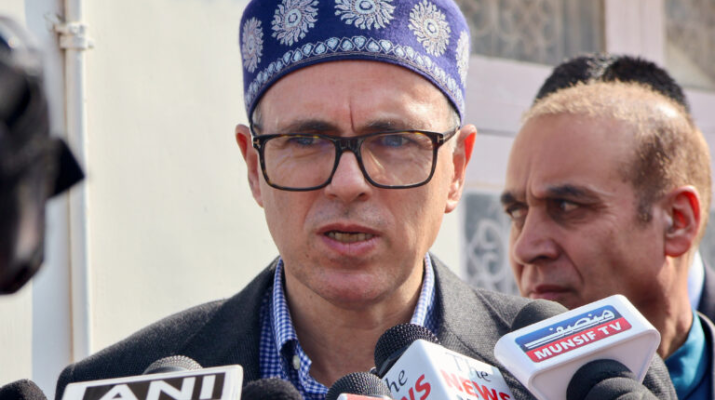
J&K Chief Minister raises concerns over outcomes of 39-day conflict involving US and Israel, calls for reflection on its impact

Jammu, April 8: Jammu and Kashmir Chief Minister Omar Abdullah on Tuesday questioned the rationale behind the recent conflict involving the United States and Israel against Iran, describing it as an “unjust war” and asking what had been achieved after weeks of hostilities.
In a post on social media platform X, Abdullah pointed to the reopening of the Strait of Hormuz following a ceasefire, noting that the strategic waterway had remained accessible prior to the conflict.
Remarks on Ceasefire and Strategic Impact
Abdullah questioned the outcome of the 39-day conflict, stating that the ceasefire had merely restored access to the Strait of Hormuz—a key global shipping route—that was already open before the escalation.
His remarks highlighted concerns over the broader consequences of the conflict, particularly in terms of its necessity and impact on regional stability.
Ceasefire and Diplomatic Developments
The comments come after reports that the United States and Iran have agreed to a ceasefire, reportedly facilitated by Pakistan. As part of the next steps, delegations from both countries are expected to meet in Islamabad on Friday.
This meeting would mark the first known direct diplomatic engagement between the two sides since early March, when tensions escalated into open conflict.
Context: Importance of the Strait of Hormuz
The Strait of Hormuz is one of the world’s most critical maritime chokepoints, through which a significant portion of global oil shipments passes. Any disruption in this route can have far-reaching implications for global energy markets and trade.
The reopening of the strait following the ceasefire is seen as a key step in stabilising regional shipping and energy flows.
Political and Public Reactions
Abdullah’s comments add to a wider debate over the justification and outcomes of the conflict. While governments involved have maintained their positions, political leaders and observers continue to assess the strategic and humanitarian implications.
Statements from political figures often reflect broader concerns about the cost of conflict and the effectiveness of military actions in resolving disputes.
Public Impact
For the global community, developments in the region directly affect energy prices, trade routes, and geopolitical stability. The ceasefire and resumption of dialogue may help ease uncertainties, though long-term outcomes remain to be seen.
Conclusion
With diplomatic talks expected to begin in Islamabad, attention is now shifting toward whether the ceasefire can lead to sustained de-escalation. Abdullah’s remarks underscore ongoing questions about the necessity and outcomes of the conflict as the situation evolves. (With inputs from H.S.)
Inputs & Images courtesy: Hindusthan Samachar (H.S.)
Edited by: Dikshita Bollu
Last Updated on: Wednesday, April 8, 2026 2:50 pm by Bollu Dikshitha | Published by: Bollu Dikshitha on Wednesday, April 8, 2026 2:50 pm | News Categories: India
About The Author
