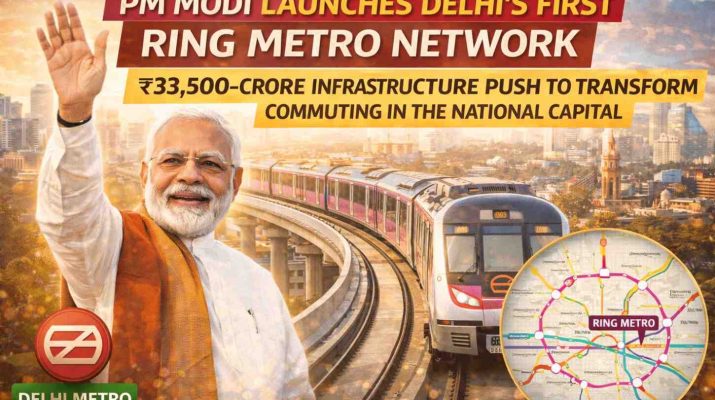
Prime Minister Narendra Modi has launched a series of major urban infrastructure projects in the national capital, including the completion of Delhi’s first operational Ring Metro network, as part of a development package worth ₹33,500 crore. The initiative marks a significant expansion of the city’s public transportation system and is expected to improve connectivity across several densely populated areas.
The newly inaugurated metro corridors form a key part of the expanding network operated by the Delhi Metro Rail Corporation (DMRC), which manages the extensive metro system in Delhi. Officials say the project aims to reduce travel times, ease congestion on existing metro routes, and provide more efficient mobility options for millions of daily commuters.
With Delhi continuing to grow as one of the world’s largest metropolitan regions, the expansion reflects the government’s broader focus on urban transport infrastructure, sustainability, and improved quality of life in Indian cities.
What Is the Ring Metro Network?
The term “Ring Metro” refers to a circular metro route that connects multiple parts of the city in a loop, allowing passengers to travel between peripheral areas without needing to pass through central hubs.
The network has effectively been completed through expansions on key metro lines, particularly the Pink Line, which now forms a circular corridor connecting several districts across Delhi. This development enables commuters to move across different parts of the city more efficiently while avoiding overcrowded interchange stations.
The Pink Line is one of the longest lines in the Delhi Metro system and connects areas across North, South, East, and West Delhi. By closing the remaining connectivity gaps, the new extension allows the line to function as a near-complete ring around the capital.
Transport planners have long viewed a circular metro corridor as an important element of large metropolitan transport networks, helping redistribute passenger loads across multiple routes rather than concentrating them in the city centre.
Key Metro Corridors Inaugurated
The latest infrastructure push includes the opening and expansion of multiple metro corridors designed to strengthen connectivity across different parts of the capital.
Pink Line Extension
One of the most significant developments is the extension of the Pink Line between Majlis Park and Maujpur-Babarpur. This section had previously been a missing link in the circular corridor. Its completion enables passengers to travel around much of the city using a single continuous route.
The new stretch includes several elevated stations that connect residential neighbourhoods and commercial zones that previously had limited metro access.
Magenta Line Connectivity
Another important component of the project is the expansion of the Magenta Line, which runs between Janakpuri West and Botanical Garden. The new extension strengthens connections between outer residential areas and major employment and commercial hubs.
Together, these corridors improve network integration across the metro system, making transfers easier and reducing travel distances for commuters moving between different parts of Delhi.
₹33,500-Crore Development Package
The metro expansions are part of a broader infrastructure investment programme valued at ₹33,500 crore, covering urban transport and government housing redevelopment projects in the capital.
A substantial portion of the funding has been allocated to expanding the metro network, which continues to serve as the backbone of Delhi’s public transport system. The remaining investment supports redevelopment projects under the government’s housing initiatives for public employees.
Infrastructure projects of this scale are designed to address the growing mobility needs of Delhi’s population, which has increased steadily over the past two decades.
Officials say the investment also supports India’s broader urban development goals, including improving sustainability, reducing congestion, and promoting public transportation as an alternative to private vehicles.
Areas Expected to Benefit
The metro extensions are expected to benefit commuters in several densely populated areas, particularly in North and East Delhi, where public transport connectivity has historically been uneven.
Neighbourhoods such as Majlis Park, Bhajanpura, Yamuna Vihar, and Maujpur are among the areas that will see improved metro access.
Residents of these areas often rely on buses or private vehicles to reach metro stations located farther away. The new stations are expected to reduce travel time for daily commuters travelling to central business districts or educational institutions.
For many passengers, improved connectivity means fewer interchanges and more direct routes to workplaces across the city.
Impact on Daily Commuting
Urban transport experts believe the completion of the Ring Metro network could significantly influence commuting patterns across Delhi.
Reduced Pressure on Central Interchange Stations
Major interchange stations such as Rajiv Chowk, Kashmere Gate, and Central Secretariat often experience heavy passenger volumes during peak hours. Circular connectivity allows passengers to bypass these hubs by travelling along alternative routes.
Shorter Travel Times
The ring corridor allows commuters to move between outer districts without detouring through central Delhi. For example, passengers travelling between North and East Delhi may now have shorter journey options.
Greater Network Resilience
Circular routes provide alternative travel options during disruptions on specific metro lines. If a particular section faces delays, commuters may still be able to reach their destination using another part of the ring.
Environmental Benefits
Expanding metro access can encourage more residents to shift from private vehicles to public transport. This could contribute to lower traffic congestion and reduced emissions in the long term.
Delhi Metro’s Growing Network
Since its launch in 2002, the Delhi Metro has evolved into one of the largest urban rail networks in the world.
The system connects multiple cities in the National Capital Region, including Noida, Gurugram, Ghaziabad, and Faridabad. With several hundred kilometres of operational track and hundreds of stations, it carries millions of passengers each day.
The metro has played a crucial role in transforming how residents travel across the capital. Prior to its expansion, commuting across the city often required long journeys through congested roads.
The system’s continued expansion is aligned with India’s broader strategy of investing in metro rail infrastructure across major cities.
Metro Expansion in India
Delhi’s metro development is part of a nationwide push to expand urban mass transit systems.
Over the past decade, metro networks have been developed or expanded in cities such as Mumbai, Hyderabad, Bengaluru, and Pune. The government has emphasized metro rail as a key solution to urban congestion in rapidly growing metropolitan regions.
Several additional metro corridors are currently under construction or planning stages across India.
These projects are aimed at supporting economic growth while improving urban mobility and reducing environmental impact.
Future Plans for Delhi’s Transport Network
Officials say that additional metro corridors are being planned as part of future expansion phases. These projects aim to extend connectivity to newer residential clusters and emerging economic zones across the National Capital Region.
The focus is increasingly shifting toward integrated transport systems, where metro lines are connected with bus networks, last-mile transport services, and pedestrian infrastructure.
Urban planners say that improving multimodal connectivity will be essential for ensuring that metro systems remain accessible and convenient for all commuters.
Why the Ring Metro Matters for Delhi
The completion of a circular metro corridor represents an important milestone for the capital’s transport network.
Large cities around the world often rely on ring transport systems to distribute passenger traffic more efficiently. By connecting multiple radial metro lines, the Ring Metro allows passengers to move between different districts without travelling through the city centre.
For a metropolis like Delhi, where millions of people commute daily, such connectivity can significantly improve the efficiency of the public transport network.
Conclusion
The launch of Delhi’s first operational Ring Metro network marks a major step in the continued evolution of the city’s transport infrastructure. By closing key connectivity gaps and expanding the metro system, the government aims to improve commuting efficiency and support sustainable urban mobility.
As Delhi’s population continues to grow, projects like these will play a critical role in shaping how residents travel across the capital. The expanded metro corridors are expected to bring long-term benefits by improving accessibility, reducing congestion, and strengthening one of India’s most important public transport systems.
For millions of commuters across the National Capital Region, the completion of the Ring Metro could make everyday travel faster, more convenient, and more reliable.
Last Updated on: Friday, March 13, 2026 11:02 pm by The Weekly News Team | Published by: The Weekly News Team on Monday, March 9, 2026 12:09 pm | News Categories: India
About The Author

