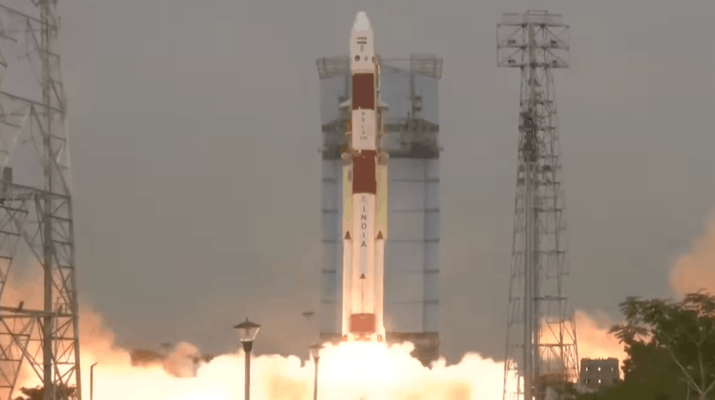
India’s space program has long been celebrated for its reliability, frugality, and quiet triumphs—from the Mars Orbiter Mission to record-breaking multi-satellite deployments. At the heart of these successes stands the Polar Satellite Launch Vehicle (PSLV), ISRO’s trusted “workhorse” that has powered over 60 successful missions since 1993, including iconic ones like Chandrayaan-1 and the 2017 launch of 104 satellites in a single go.
Yet, on January 12, 2026, that reputation took a sharp hit. The PSLV-C62 mission, carrying the strategic EOS-N1 (Anvesha) Earth observation satellite developed with DRDO involvement, plus 15 co-passenger payloads from Indian startups, universities, and international partners (including Brazil, Nepal, Spain, and tech demos like OrbitAID’s in-orbit refueling satellite and Europe’s KID re-entry capsule), ended in failure. Just eight minutes after a flawless liftoff from Sriharikota at 10:18 AM IST, an anomaly struck during the third stage (PS3), causing a deviation in flight path and preventing orbital insertion. All 16 satellites were lost.
This wasn’t an isolated incident. It marked the second consecutive PSLV failure—the first being PSLV-C61 in May 2025, which also faltered in the third stage while attempting to deploy the EOS-09 (RISAT-1B) radar imaging satellite due to a drop in combustion chamber pressure.
The Technical Heart of the Trouble: The Third Stage
The PSLV is a four-stage rocket: two solid-propellant stages (PS1 and PS3), two liquid stages (PS2 and PS4). The third stage (PS3)—a high-performance solid motor—is crucial. It provides the rapid acceleration needed to reach orbital velocity (around 7.8 km/s) after the initial boost from the first two stages. Without it firing perfectly, the vehicle can’t achieve the required speed to stay in orbit; gravity pulls everything back down.
In both recent failures:
- Early stages performed nominally.
- Trouble emerged near the end of the PS3 burn: roll disturbances, flight path deviation (C62), or chamber pressure drop (C61).
- Result: sub-orbital trajectory, satellites re-entering and burning up or splashing down uncontrolled.
ISRO Chairman V. Narayanan described the C62 anomaly as a “disturbance in roll rates” followed by path deviation, with teams analyzing telemetry from all tracking stations. Preliminary indications point to similar root causes—possible issues with solid propellant quality, flex nozzle performance, casing integrity, or combustion anomalies in the PS3 motor.
These are rare for PSLV, which had only three major failures in 63 prior flights (including its 1993 debut and a 2017 partial failure). Two back-to-back in under nine months, both tied to the same stage, suggest a systemic issue that may have gone unaddressed or undetected after the C61 probe.
Broader Implications: From National Security to Commercial Credibility
The losses are painful on multiple fronts.
Strategically, Anvesha (EOS-N1) was a hyperspectral imaging satellite for advanced surveillance—capable of detecting camouflaged military assets, environmental changes, agriculture monitoring, and more. Its loss, following the 2025 EOS-09 setback, delays India’s space-based reconnaissance capabilities amid regional security dynamics.
Commercially, PSLV-C62 was a NewSpace India Limited (NSIL) mission with international customers. Payloads from startups (e.g., OrbitAID’s pioneering refueling demo) and foreign entities now face destruction without insurance payouts in many cases. This erodes trust in India’s low-cost launch services, especially as private players like SpaceX dominate rideshares.
Institutionally, questions arise about transparency. The Failure Analysis Committee (FAC) report for PSLV-C61 was not publicly released (though reportedly submitted internally), departing from ISRO’s historical norm of sharing lessons learned. Launching C62 without full disclosure of fixes risks repeating mistakes.
For India’s ambitious 2026 calendar—including Gaganyaan uncrewed tests, NavIC expansions, and more commercial flights—these setbacks create uncertainty. PSLV is grounded pending fixes, pressuring timelines and shifting reliance to alternatives like the heavier LVM3.
The Path Forward: Resilience in Adversity
Space is hard, and even legends stumble. ISRO has a proven track record of rebounding—after early PSLV teething issues, it achieved near-perfect reliability for decades. The agency’s modular design allows targeted fixes: propellant reformulation, enhanced quality checks, nozzle redesigns, or better ground testing.
Expect a thorough root-cause investigation, likely involving simulation, hardware teardowns, and corrective actions before return-to-flight. History suggests ISRO will emerge stronger, with improved processes that benefit future vehicles like the Next Generation Launch Vehicle.
These rare double troubles are a reminder: reliability isn’t guaranteed—it’s earned through relentless scrutiny. For India’s space future—human spaceflight, lunar/planetary exploration, and a thriving private ecosystem—the stakes are high. But if past is prologue, ISRO’s engineers will turn this setback into fuel for greater achievements.
The stars are still within reach. The question is how quickly the workhorse gets back on its feet.
Last Updated on: Tuesday, January 13, 2026 3:36 pm by Monisha Angara | Published by: Monisha Angara on Tuesday, January 13, 2026 3:36 pm | News Categories: News
About The Author
