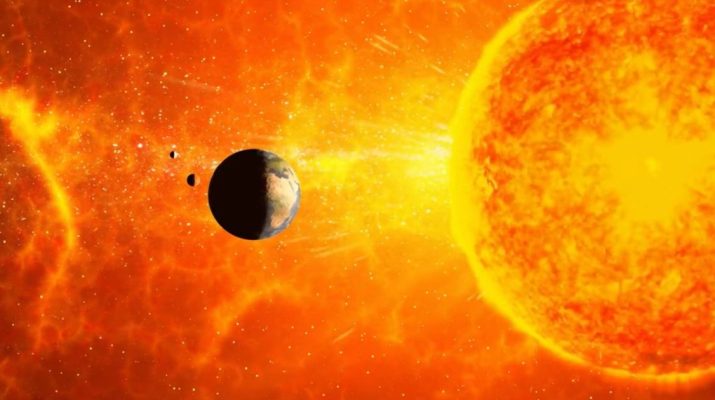
The Sun has unleashed one of its most powerful outbursts in over two decades, slamming Earth with a severe solar radiation storm classified as S4 the highest level on NOAA’s scale since the infamous Halloween storms of October 2003. This rare event, which peaked around January 19, 2026, triggered breathtaking auroral displays visible far from the poles and raised alerts about potential disruptions to satellites, aviation, and space operations.
What Exactly Happened?
It all started with a powerful X1.9-class solar flare erupting from the Sun on January 18, 2026. Solar flares are massive bursts of energy and radiation from the Sun’s surface. This one launched a fast-moving coronal mass ejection (CME) a huge cloud of magnetized plasma—and accelerated a flood of high-energy charged particles (mostly protons) toward Earth.
These particles arrived quickly, intensifying into a solar radiation storm that reached S4 (Severe) levels by January 19. NOAA’s Space Weather Prediction Center (SWPC) confirmed this as the strongest solar radiation storm in more than 20 years. At the same time, the CME’s impact created a G4 (Severe) geomagnetic storm, distorting Earth’s magnetic field and allowing auroras to dance across unusually low latitudes.
The radiation storm is driven by solar energetic particles (SEPs), while the geomagnetic storm comes from the CME’s magnetic fields interacting with ours. Together, they created a dramatic double whammy of space weather.
A Spectacular Northern Lights Show
The highlight for skywatchers? Vivid auroras lighting up skies in places that rarely see them.
- Reports poured in of northern lights visible across much of the United States (as far south as Alabama, Texas, Northern California, and even parts of the southern border states).
- Sightings extended to Europe, Asia, and other mid-latitude regions.
- The G4 geomagnetic conditions pushed the auroral oval southward, creating widespread “once-in-a-generation” displays on January 19–20.
Many shared stunning photos of green, purple, and red curtains dancing overhead social media exploded with viewer-submitted images from backyards, cities, and remote spots.
Real-World Impacts and Warnings
While the event posed no direct danger to people on the ground (Earth’s atmosphere and magnetic field provide strong protection), it carried risks for technology and high-altitude activities:
- Aviation: Increased radiation exposure for flights over polar routes; airlines rerouted some paths and crews monitored dosage.
- Satellites: Heightened risk of damage to electronics, especially in geostationary orbits; potential temporary disruptions to communications, imaging, and navigation.
- Space launches and operations: Delays or holds possible; astronauts on the ISS faced elevated radiation levels and adjusted schedules.
- GPS and navigation: Minor signal degradation or errors in high-latitude areas due to ionospheric disturbances.
- HF radio communications: Blackouts in polar regions.
- Power grids: Low risk of widespread issues (unlike extreme G5 events), but possible localized voltage fluctuations.
SWPC notified stakeholders like NASA, FAA, FEMA, and airlines in advance. As of January 21, 2026, conditions are easing, but lingering effects from the CME passage could continue for a day or two.
Why This Matters in Solar Cycle 25
We’re near the peak of Solar Cycle 25, and activity remains high even post-peak. Events like this remind us the Sun is far from quiet.
- The last comparable S4 radiation storm was in 2003, which caused satellite outages and GPS/radio disruptions.
- Recent storms (like May 2024’s G5 event) showed how modern tech vulnerabilities grow with reliance on satellites and precise navigation.
This January 2026 storm underscores the importance of space weather forecasting. Agencies like NOAA, ESA, and others monitor the Sun 24/7 to give advance warnings helping mitigate costly disruptions.
How to Catch Future Displays
If you missed this one, keep an eye on aurora forecasts:
- Check NOAA SWPC’s aurora viewline or apps like Aurora Alerts.
- Head to dark-sky locations away from city lights during high geomagnetic activity (Kp index 5+).
- Best times: evenings after sunset, especially during equinox seasons.
Space weather can turn ordinary nights magical. The Sun’s latest tantrum delivered both awe-inspiring beauty and a timely reminder of our connected, vulnerable place in the solar system.
Also Read: Shadowfax IPO GMP Rises: Will Investors See 8-12% Listing Profits On January 28?
Add The Weekly News as preferred source on google – click here
Last Updated on: Wednesday, January 21, 2026 4:44 pm by Monisha Angara | Published by: Monisha Angara on Wednesday, January 21, 2026 4:44 pm | News Categories: Trending
About The Author
