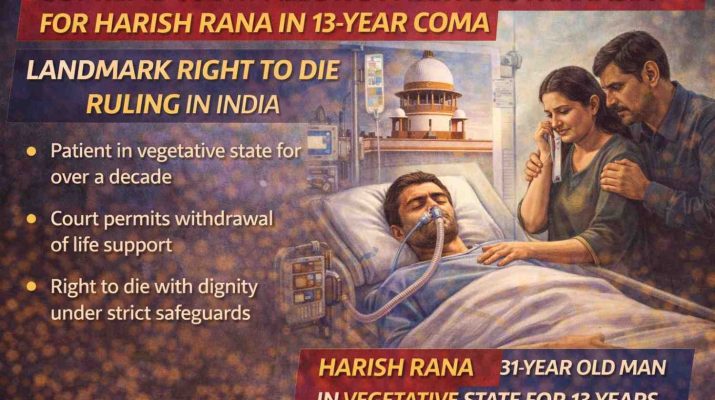
In a significant legal development that has reignited debate around the right to die with dignity, the Supreme Court of India has permitted passive euthanasia for 31-year-old Harish Rana, who has remained in a vegetative state for over 13 years.
The ruling is being described by legal observers as a landmark decision in India’s evolving euthanasia jurisprudence, as it applies existing constitutional principles to a deeply complex medical and ethical situation. The case has drawn nationwide attention from legal experts, medical professionals, and human rights advocates.
The decision also revisits the constitutional interpretation of Article 21 — the right to life — and its relationship with the right to die with dignity, an issue that the Supreme Court has addressed in multiple historic judgments over the past decade.
The Harish Rana Case: 13 Years in a Vegetative State
Harish Rana reportedly slipped into a vegetative condition more than a decade ago following a severe medical event that caused irreversible brain damage. Since then, he has been dependent on life-support measures and round-the-clock medical care.
According to the petition presented before the court, medical evaluations indicated that Rana had no realistic prospects of neurological recovery. The prolonged condition placed an emotional and financial burden on his family, who sought legal permission to withdraw life-sustaining treatment.
Passive euthanasia refers to withholding or withdrawing medical support that artificially prolongs life, allowing the patient to pass away naturally. Unlike active euthanasia—which involves actively administering substances to end life—passive euthanasia focuses on stopping extraordinary medical interventions.
After reviewing medical reports and legal arguments, the court allowed the withdrawal of life-sustaining treatment under strict guidelines.
What the Supreme Court Ruled
The bench of the Supreme Court of India observed that the Constitution protects not only the right to live but also the right to die with dignity under specific circumstances.
In permitting passive euthanasia in the Harish Rana case, the court emphasized that:
- The decision must be based on verified medical assessments confirming irreversible conditions.
- The patient must be in a permanent vegetative or terminal state with no meaningful recovery expected.
- The request must follow established legal safeguards to prevent misuse.
The court also stressed that such cases require careful judicial scrutiny and adherence to medical protocols to ensure that decisions are made ethically and lawfully.
Understanding Passive Euthanasia in India
Passive euthanasia is legally recognized in India under certain circumstances following a series of landmark Supreme Court rulings.
The legal framework was shaped primarily by the 2018 judgment in the Common Cause v. Union of India case, where the court formally recognized the right to die with dignity as part of Article 21 of the Constitution.
That ruling established several key principles:
- Patients have the right to refuse life-sustaining treatment in certain conditions.
- Individuals may create living wills specifying their end-of-life medical preferences.
- Passive euthanasia may be permitted under strict legal and medical supervision.
The Harish Rana verdict is being viewed as a practical application of these principles.
Ethical and Medical Considerations
Cases involving euthanasia inevitably raise complex ethical questions.
Medical professionals often face difficult decisions when dealing with patients who have no prospect of recovery but continue to survive through artificial medical intervention.
Some ethical concerns include:
- Determining whether recovery is medically impossible
- Balancing the sanctity of life with the concept of dignity
- Ensuring that family members are not pressured into decisions
- Preventing potential misuse of euthanasia provisions
In India, courts have attempted to address these concerns by establishing multi-layered approval mechanisms, including medical boards and judicial oversight.
The Role of Living Wills
The concept of a living will, also recognized by the Supreme Court, allows individuals to specify how they wish to be treated medically if they become incapacitated.
A living will can include instructions about:
- Refusing life-support systems
- Avoiding artificial ventilation
- Declining feeding tubes or other invasive procedures
While the Harish Rana case did not involve a pre-existing living will, the ruling has renewed discussions about the importance of advance medical directives.
Legal experts say increased public awareness about living wills could help families and doctors navigate similar situations in the future.
Public and Legal Reactions
The ruling has triggered significant debate across legal and medical circles.
Supporters argue that allowing passive euthanasia in carefully regulated circumstances respects human dignity and reduces prolonged suffering for patients and families.
Others remain cautious, warning that euthanasia policies must include strong safeguards to prevent potential abuse.
Human rights advocates have also emphasized the need for improved palliative care systems so that terminally ill patients receive adequate medical and psychological support.
Broader Implications of the Verdict
The Harish Rana case may influence how courts and hospitals handle similar petitions in the future.
Legal experts believe the ruling reinforces three important principles:
- Recognition of dignity in end-of-life decisions
- Strict judicial oversight in euthanasia cases
- The importance of medical evidence in determining irreversible conditions
The judgment also highlights the increasing role of constitutional courts in navigating ethical dilemmas created by advances in modern medical technology.
The Ongoing Debate on the Right to Die
Globally, euthanasia laws vary widely. Some countries allow both passive and active euthanasia under regulated conditions, while others prohibit the practice entirely.
India’s legal framework remains cautious, permitting only passive euthanasia with strict safeguards.
The Harish Rana verdict adds another chapter to the evolving discussion about how societies balance medical technology, personal dignity, and the value of life.
Conclusion
The decision by the Supreme Court of India to permit passive euthanasia for Harish Rana represents a significant moment in India’s legal and ethical discourse on end-of-life care.
While the ruling applies specifically to this case, it reinforces broader constitutional principles established in Common Cause v. Union of India regarding the right to die with dignity.
As medical technology continues to extend life in unprecedented ways, cases like this are likely to remain at the center of debates about law, ethics, and human compassion in modern healthcare.
Last Updated on: Saturday, March 14, 2026 12:15 am by The Weekly News Team | Published by: The Weekly News Team on Wednesday, March 11, 2026 3:26 pm | News Categories: India
About The Author

