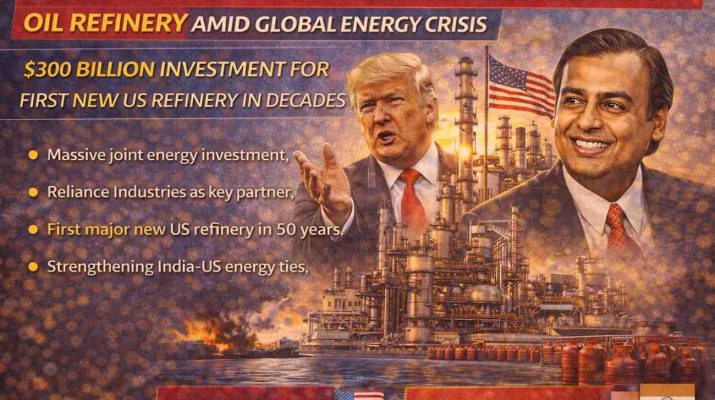
In a development that could reshape global energy partnerships, Donald Trump has announced a massive $300-billion investment initiative to build a new oil refinery in the United States, marking what is being described as the first major new refinery project in the country in nearly five decades.
A significant portion of the investment is expected to come from India’s energy giant Reliance Industries, led by billionaire industrialist Mukesh Ambani. The announcement has quickly drawn attention across global business and political circles, highlighting a potential new phase of collaboration between Indian and American energy companies.
The proposed refinery project comes at a time when global fuel markets are facing volatility due to geopolitical tensions, supply disruptions, and growing energy demand across major economies.
A $300 Billion Energy Investment Plan
The refinery project, according to early announcements, would represent one of the largest energy infrastructure investments in modern history.
While detailed technical plans have yet to be publicly released, the initiative is expected to involve:
- Construction of a large-scale crude oil processing facility
- Strategic investment from international energy companies
- Advanced refining technology to improve efficiency
- Expanded capacity for processing different types of crude oil
The project could significantly expand the United States’ ability to refine crude domestically, reducing reliance on aging infrastructure.
Industry analysts say the scale of the proposed investment suggests the refinery could become one of the most important energy facilities globally.
Reliance’s Role in the Project
Reliance Industries has emerged as a key partner in the proposed refinery development. The company already operates one of the world’s largest refining complexes in India and has extensive experience in large-scale energy infrastructure.
Led by Mukesh Ambani, Reliance has expanded its presence across multiple sectors including petrochemicals, telecommunications, digital services, and renewable energy.
Participation in a U.S. refinery project could strengthen the company’s global energy footprint while deepening economic ties between India and the United States.
Energy experts note that Reliance’s technical expertise in refining operations makes it a natural partner for such a large-scale project.
Why the United States Has Not Built New Refineries in Decades
The announcement has attracted particular attention because the United States has not constructed a completely new major oil refinery in nearly 50 years.
Several factors contributed to this long gap:
Environmental Regulations
Stricter environmental standards made new refinery construction more complex and expensive.
High Capital Costs
Large refineries require billions of dollars in investment and long development timelines.
Market Shifts
The global energy market has gradually shifted toward cleaner fuels and renewable energy sources.
Expansion of Existing Facilities
Instead of building new plants, companies often expanded or upgraded existing refineries to increase capacity.
The proposed project therefore represents a rare move toward building a new large-scale refining facility.
Strategic Importance Amid Global Energy Uncertainty
The timing of the refinery announcement coincides with heightened volatility in global energy markets.
Several developments have contributed to the uncertainty:
- Geopolitical tensions affecting oil supply routes
- Production decisions by major oil-producing nations
- Fluctuating global fuel demand
- Ongoing energy transition debates
Building additional refining capacity could help stabilize fuel supply and reduce bottlenecks between crude oil production and refined fuel distribution.
Energy analysts say large refining hubs can also play a strategic role in ensuring national energy security.
Economic Impact of the Project
If completed, the refinery could generate significant economic activity in the region where it is built.
Potential benefits include:
- Thousands of construction jobs during development
- Long-term employment in refinery operations
- Increased demand for supporting industries such as transportation and logistics
- Expanded domestic fuel production capacity
Large refinery projects also typically involve extensive supply chains including engineering, manufacturing, and technology services.
For both American and Indian companies, the project could create new investment and partnership opportunities.
India–US Energy Collaboration
The involvement of Reliance Industries highlights the growing economic relationship between India and the United States in the energy sector.
Over the past decade, cooperation between the two countries has expanded in areas such as:
- Oil and gas trade
- Strategic petroleum reserves
- Energy technology partnerships
- Clean energy initiatives
Participation in a major refinery project in the United States would represent another milestone in this evolving partnership.
Questions and Next Steps
Despite the headline-grabbing announcement, many details about the refinery project remain under discussion.
Key questions include:
- The specific location of the refinery
- The timeline for construction
- Regulatory approvals required
- Final investment structure among participating companies
Large infrastructure projects of this scale typically take several years to complete, involving environmental reviews, financial arrangements, and engineering planning.
Industry observers will be watching closely as more details emerge.
Conclusion
The proposed $300-billion refinery initiative announced by Donald Trump, with investment support from Reliance Industries led by Mukesh Ambani, has quickly become one of the most talked-about developments in the global energy sector.
If realized, the project would mark the first major new oil refinery built in the United States in decades, reflecting both economic opportunity and strategic energy planning.
At a time when the global energy landscape is undergoing rapid change, the Trump-Ambani refinery initiative could signal a new phase of international cooperation in securing fuel supply and strengthening energy infrastructure.
Last Updated on: Saturday, March 14, 2026 12:30 am by The Weekly News Team | Published by: The Weekly News Team on Wednesday, March 11, 2026 3:38 pm | News Categories: world
About The Author

