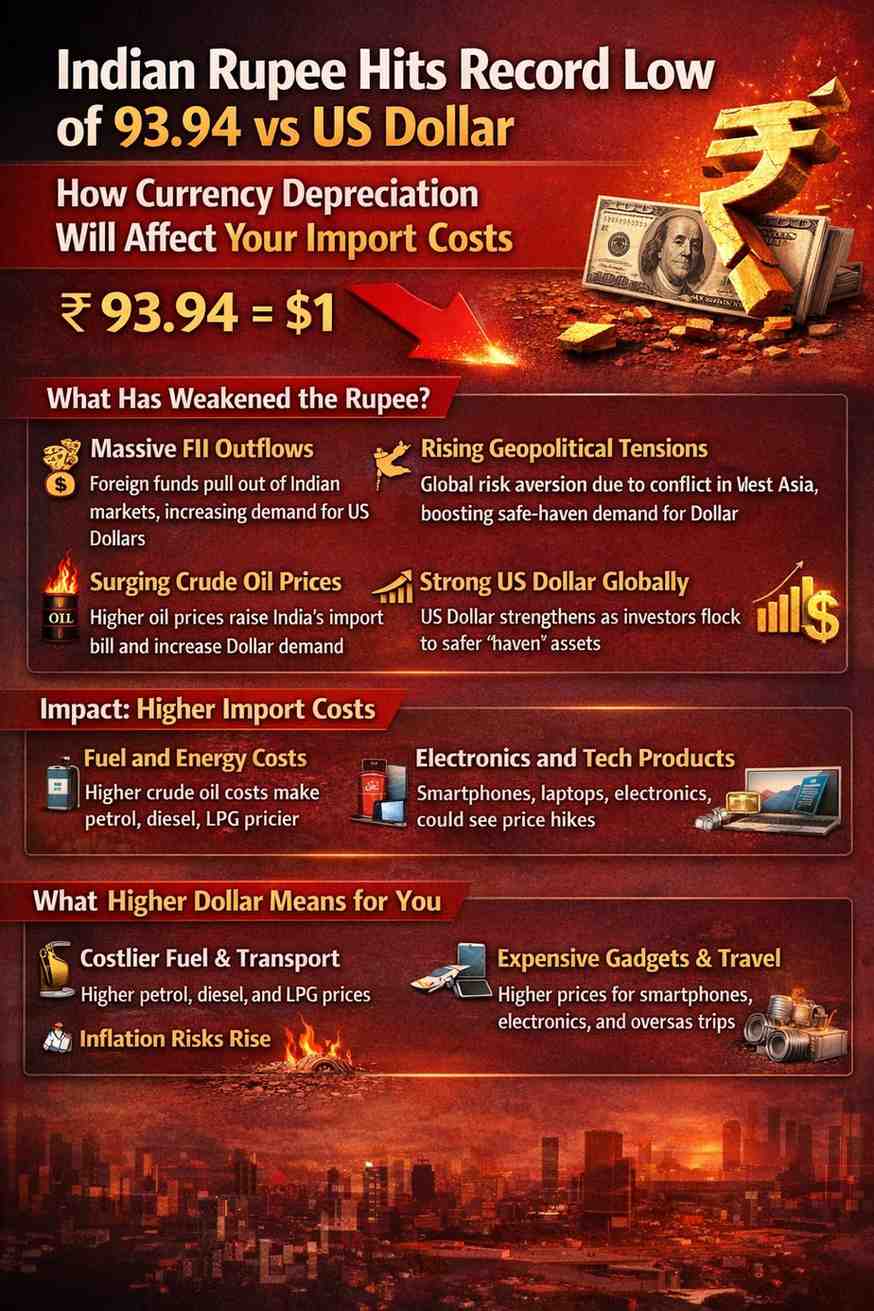
The Indian currency has slipped to its weakest level in history, with the Indian Rupee falling to around ₹93.94 against the United States Dollar in early trade on Monday. The sharp depreciation comes amid heavy foreign institutional investor (FII) outflows, global risk aversion, and rising geopolitical tensions that have rattled financial markets.
Currency traders say the slide reflects growing pressure on emerging market currencies as global investors move capital toward safer assets. For India, the weakening rupee has immediate implications for import costs, inflation, and corporate earnings.
Why the Rupee Has Fallen to an All-Time Low
Several global and domestic factors have converged to push the rupee to record levels.
1. Massive FII Outflows
Foreign portfolio investors have been pulling money out of Indian equities and debt markets amid global uncertainty. When FIIs sell Indian assets, they convert rupees into dollars, increasing demand for the US currency and weakening the rupee.
Market data suggests sustained outflows over recent sessions have intensified downward pressure on the currency.
2. Rising Global Risk Due to Geopolitical Tensions
Escalating conflict in West Asia has created turbulence in financial markets. Investors typically shift funds toward safe-haven assets such as the US dollar during geopolitical crises.
This flight to safety has strengthened the dollar globally while weakening currencies of emerging economies like India.
3. Surging Crude Oil Prices
India imports more than 80% of its crude oil needs. When oil prices rise, the country’s import bill increases significantly.
To pay for these imports, Indian refiners require more dollars, increasing demand for the US currency and further weakening the rupee.
4. Stronger US Dollar Globally
The dollar has been gaining strength against several major currencies due to economic resilience in the United States and expectations of tighter financial conditions.
When the dollar strengthens globally, emerging market currencies usually face depreciation pressure.
Impact on India’s Import Costs
A weaker rupee makes imported goods more expensive. Since India relies heavily on imports for several critical commodities and products, the effects can be widespread.
Fuel and Energy Costs
Crude oil imports become costlier when the rupee weakens. This can eventually translate into higher petrol, diesel, and LPG prices.
Electronics and Technology Products
Items such as smartphones, laptops, and semiconductors — many of which are imported — could see price increases.
Industrial Raw Materials
Manufacturers importing metals, chemicals, or machinery may face higher input costs, potentially affecting production and consumer prices.
Inflation Concerns Could Rise
Currency depreciation often feeds into inflation because higher import costs push up prices across sectors.
Economists warn that if the rupee remains weak for a prolonged period, it could influence:
- Retail inflation levels
- Transport and logistics costs
- Consumer electronics prices
- Airline ticket prices due to higher aviation fuel costs
This could complicate policy decisions for the Reserve Bank of India, which closely monitors inflation and currency stability.
Who Benefits from a Weak Rupee?
While a depreciating currency poses challenges, some sectors may benefit.
IT and Software Exporters
Companies earning revenue in dollars, such as IT services firms, gain when those earnings are converted into rupees.
Pharmaceutical Exporters
Drug manufacturers selling to international markets also benefit from favourable exchange rates.
NRI Remittances
Non-resident Indians sending money home see their remittances convert into higher rupee amounts.
RBI’s Role in Stabilising the Currency
The Reserve Bank of India typically intervenes in foreign exchange markets to reduce excessive volatility.
Possible measures include:
- Selling dollars from foreign exchange reserves
- Adjusting liquidity conditions in the banking system
- Coordinating with the government on macroeconomic stability
India’s foreign exchange reserves provide a cushion that can help moderate sharp currency swings.
What This Means for Indian Consumers
For ordinary households, currency movements may appear distant but have tangible consequences.
Potential impacts include:
- Higher fuel prices
- Increased costs of imported gadgets
- Expensive foreign travel and overseas education
- Possible rise in airline ticket prices
However, not all price changes occur immediately, as government policies and company strategies often influence how costs are passed on to consumers.
Outlook: Can the Rupee Recover?
Currency markets remain highly sensitive to global developments. Analysts say the rupee’s trajectory will depend on:
- Stability in global oil prices
- Direction of foreign capital flows
- Monetary policy signals from major economies
- Geopolitical developments in energy-producing regions
A recovery in global risk appetite or easing oil prices could help stabilise the rupee in the coming weeks.
Conclusion
The fall of the Indian Rupee to an all-time low near ₹93.94 per United States Dollar underscores how global financial flows and geopolitical shocks can quickly influence domestic economic conditions.
While the depreciation may benefit export-driven sectors, it also raises concerns about inflation, fuel costs, and import expenses. As policymakers and markets respond to the evolving situation, currency stability will remain a key focus for investors, businesses, and consumers across India. 📉💱
Last Updated on: Monday, March 23, 2026 9:49 pm by The Weekly News Team | Published by: The Weekly News Team on Monday, March 23, 2026 2:47 pm | News Categories: Business
About The Author