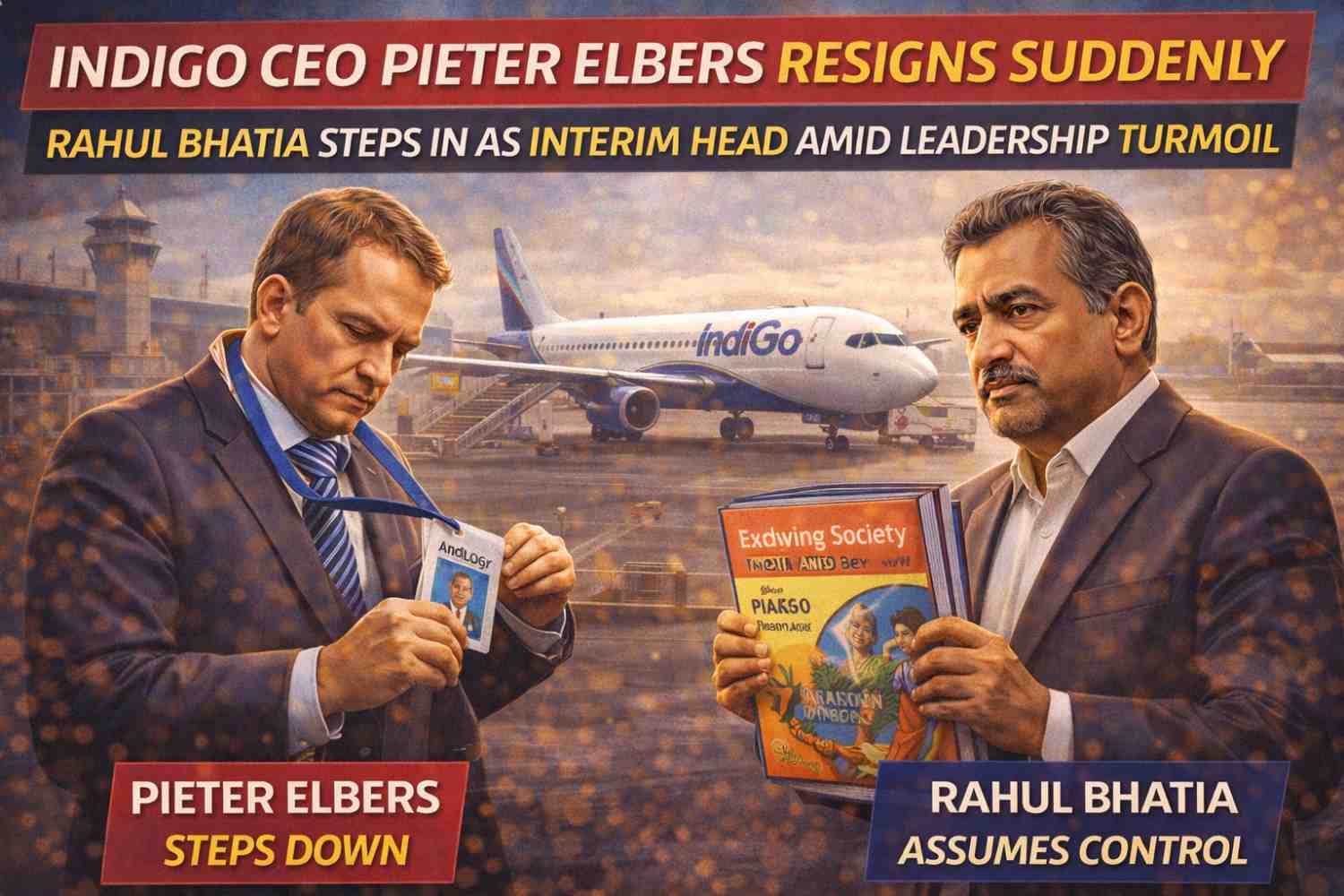
India’s largest airline, IndiGo, is facing an unexpected leadership shake-up after CEO Pieter Elbers stepped down with immediate effect. The sudden exit has triggered intense attention across India’s aviation and business sectors, particularly given the airline’s dominant position in the country’s rapidly expanding aviation market.
Following Elbers’ resignation, IndiGo co-founder Rahul Bhatia has assumed charge as interim head, ensuring operational continuity while the company evaluates its long-term leadership strategy. The development comes only months after a series of operational and reputational challenges for the airline, raising questions about governance, strategy, and the future direction of the carrier.
For investors, employees, and millions of passengers who rely on IndiGo each year, the leadership transition marks a critical moment for India’s largest aviation brand.
Leadership Exit Comes at a Critical Moment for IndiGo
The abrupt resignation of Pieter Elbers has surprised industry observers because he had been widely seen as a central figure in IndiGo’s international expansion strategy.
Elbers joined the airline after a long career at European carrier KLM and took charge at IndiGo during a period when India’s aviation market was witnessing unprecedented growth. Under his leadership, the airline pushed aggressively into new international routes while continuing to strengthen its position in domestic travel.
However, the timing of the resignation — described as effective immediately — has sparked speculation across the aviation industry about internal pressures and operational challenges within the company.
IndiGo has not publicly detailed the specific reasons behind the leadership change, but the move follows months of turbulence for the airline, including operational disruptions, passenger complaints, and strategic recalibrations.
For a company that commands the largest share of India’s domestic aviation market, stability at the top remains crucial.
Rahul Bhatia Takes Interim Control
With the CEO stepping down, Rahul Bhatia has stepped in as interim leader to steer the airline through the transition period.
Bhatia, one of the founding figures behind IndiGo, is widely regarded as a key architect of the airline’s business model and long-term vision. Through the airline’s parent entity InterGlobe Aviation, he has played a central role in shaping IndiGo’s strategy since its launch in 2006.
Industry analysts note that Bhatia’s direct involvement in day-to-day leadership could reassure stakeholders during the current period of uncertainty. His deep familiarity with the airline’s operations and strategic priorities may help maintain stability as the company searches for a permanent replacement.
However, the transition also highlights the continuing influence of IndiGo’s founding leadership in shaping its corporate direction.
IndiGo’s Dominance in India’s Aviation Market
The leadership crisis arrives at a time when IndiGo continues to dominate India’s aviation sector.
Over the past decade, the airline has built a reputation as the country’s most reliable and efficient low-cost carrier. Its consistent focus on operational efficiency, aircraft utilization, and cost discipline has helped it achieve a commanding share of domestic passenger traffic.
Several factors have contributed to IndiGo’s rise:
Operational efficiency
IndiGo’s business model emphasizes quick turnaround times, standardized aircraft fleets, and streamlined operations — elements that reduce costs and improve profitability.
Expanding route network
The airline has steadily expanded both domestic and international routes, connecting Indian cities with destinations across Asia, the Middle East, and Europe.
Fleet expansion
IndiGo operates one of the largest fleets in India, consisting primarily of Airbus aircraft. Large aircraft orders have supported the airline’s long-term growth plans.
Growing passenger demand
India’s aviation market is among the fastest growing in the world, driven by rising incomes, urbanization, and increasing demand for affordable air travel.
Despite these strengths, recent challenges have highlighted the complexity of managing rapid expansion in a competitive and highly regulated industry.
Operational Challenges and Industry Pressures
In recent months, IndiGo has faced several operational challenges that placed the airline under public scrutiny.
Passengers reported delays, schedule disruptions, and customer service concerns during periods of high travel demand. Such issues can quickly escalate in India’s digital ecosystem, where social media amplifies consumer experiences in real time.
Airlines globally have also been navigating a complex environment shaped by:
- Rising fuel prices
- Supply chain disruptions affecting aircraft deliveries
- Airspace restrictions due to geopolitical tensions
- Increasing airport congestion in major cities
For IndiGo, managing these external pressures while maintaining its low-cost structure remains a critical balancing act.
Leadership stability is therefore particularly important during periods of operational strain.
What the Leadership Change Means for IndiGo’s Strategy
The sudden leadership transition raises broader questions about the airline’s strategic priorities.
Pieter Elbers was widely associated with IndiGo’s international growth push. The airline had been expanding aggressively into global markets, aiming to transform itself from a predominantly domestic carrier into a major international player.
This strategy included:
- Launching new international routes
- Increasing wide-body aircraft plans
- Strengthening partnerships with global airlines
With Rahul Bhatia temporarily at the helm, analysts will be closely watching whether IndiGo maintains the same pace of international expansion or adjusts its approach.
Corporate leadership changes often lead to shifts in strategic priorities, particularly when companies are navigating competitive or operational challenges.
Investor and Market Reactions
Leadership changes at major corporations frequently trigger attention from investors and financial markets.
InterGlobe Aviation, the parent company of IndiGo, is closely followed by analysts due to its central role in India’s aviation sector. Investors typically view leadership stability as an important indicator of long-term business performance.
Market observers will be watching several key signals in the coming weeks:
- Whether IndiGo announces a permanent CEO appointment
- Any changes to the airline’s expansion strategy
- Updates on operational performance and passenger growth
- Management commentary in upcoming financial disclosures
For a company of IndiGo’s scale, leadership continuity plays a significant role in maintaining investor confidence.
India’s Aviation Sector at an Inflection Point
The leadership transition at IndiGo also reflects the broader transformation underway in India’s aviation sector.
India is now one of the world’s fastest-growing aviation markets, with passenger numbers rising steadily each year. Government infrastructure projects — including new airports and airport expansions — are expected to further boost capacity and connectivity.
At the same time, competition among airlines is intensifying as carriers expand fleets and routes to capture growing demand.
Key trends shaping the sector include:
- Rapid fleet expansion by Indian airlines
- Growth of regional connectivity programs
- Increasing international travel demand
- Infrastructure upgrades across major airports
In such an environment, leadership decisions at dominant carriers like IndiGo can influence the broader trajectory of the industry.
What Comes Next for IndiGo
For now, Rahul Bhatia’s interim leadership provides short-term stability while the company determines its next steps.
Key questions remain about the timeline for appointing a permanent CEO and whether IndiGo will continue its existing growth strategy or recalibrate its priorities.
The airline’s immediate focus is likely to remain on:
- Maintaining operational reliability
- Strengthening customer experience
- Managing fleet expansion plans
- Preserving its strong position in the domestic market
With millions of passengers flying IndiGo each year, the company’s leadership decisions carry implications not only for investors but also for the broader travel ecosystem in India.
Conclusion
The sudden resignation of Pieter Elbers marks a significant moment for IndiGo, one of India’s most influential airlines. While the appointment of Rahul Bhatia as interim head ensures continuity, the leadership change arrives at a time when the aviation sector is undergoing rapid growth and transformation.
For passengers, employees, and investors alike, the coming months will be crucial in determining how IndiGo navigates this transition — and how it positions itself for the next phase of expansion in India’s dynamic aviation market.
Last Updated on: Friday, March 13, 2026 11:40 pm by The Weekly News Team | Published by: The Weekly News Team on Tuesday, March 10, 2026 10:33 pm | News Categories: Business
About The Author