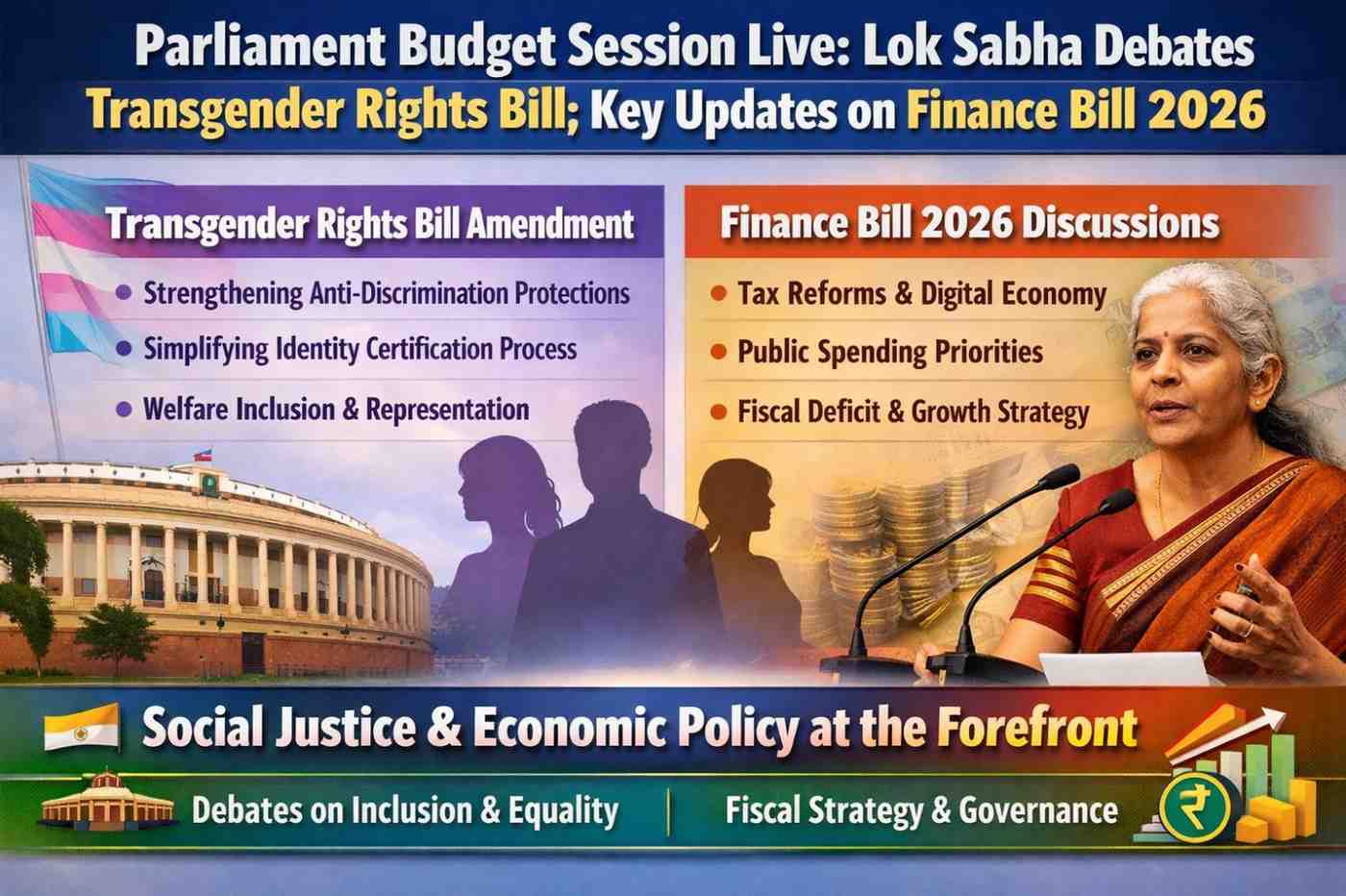
India’s Budget Session of Parliament has entered a decisive stage, with high-stakes debates unfolding in the Lok Sabha over proposed amendments to transgender rights legislation alongside scrutiny of the Finance Bill 2026. The developments are drawing national attention as lawmakers deliberate on policy changes that could influence social inclusion frameworks, fiscal priorities, and economic governance in the coming financial year. 🇮🇳🏛️
The simultaneous focus on social justice reforms and taxation measures highlights the wide legislative agenda being pursued during the session, with implications for citizens, businesses, and institutional policymaking across India.
Transgender Rights Bill Amendment: Key Issues in Focus
The proposed amendments to the Transgender Persons (Protection of Rights) framework have emerged as one of the most closely watched legislative matters of the session. Members of Parliament are examining how existing provisions can be strengthened to ensure better implementation and enhanced safeguards for transgender persons.
Strengthening Anti-Discrimination Measures
A major theme of the debate is the need to improve enforcement of anti-discrimination protections in sectors such as education, employment, healthcare, and housing. Lawmakers have emphasised that legal recognition alone is insufficient unless supported by clear accountability mechanisms and administrative clarity.
Policy experts note that improved compliance frameworks could help translate statutory protections into tangible outcomes, including increased access to opportunities and public services. At the same time, discussions have highlighted the importance of coordination between central ministries and state governments for effective rollout.
Identity Certification and Administrative Processes
Another critical issue under consideration is the process of gender identity certification. Several MPs have called for simplifying documentation requirements and ensuring that procedures respect individual autonomy and dignity.
Advocacy groups have long argued that bureaucratic complexities can limit access to welfare benefits, healthcare entitlements, and educational opportunities. Legislative refinements, if enacted, could therefore play a significant role in shaping how transgender persons engage with public institutions.
Welfare Inclusion and Representation
Some members have also raised the question of targeted welfare measures and structured inclusion in government schemes. While there is no consensus yet on the precise form such provisions may take, the broader discussion reflects growing recognition of the socio-economic challenges faced by the transgender community.
Legal observers suggest that any amendments passed during this session could influence future policy design and judicial interpretation concerning equality and non-discrimination under constitutional principles.
Finance Bill 2026: Fiscal Strategy and Policy Priorities
Alongside social legislation, Parliament is engaged in detailed examination of the Finance Bill introduced by Union Finance Minister Nirmala Sitharaman. The Bill sets out the government’s revenue mobilisation strategy and outlines spending priorities across key sectors.
Taxation Provisions and Compliance Reforms
Discussions have centred on proposed changes to capital gains taxation norms, compliance requirements for startups, and measures aimed at widening the tax base in the digital economy. Policymakers have underscored the need to balance fiscal consolidation with maintaining an investment-friendly environment.
Industry stakeholders and financial analysts are closely tracking these developments, given their potential impact on corporate planning, market sentiment, and entrepreneurial activity. While some experts view reforms as necessary for transparency and efficiency, others have urged clarity to minimise uncertainty.
Public Spending and Developmental Allocations
The Finance Bill also addresses government expenditure priorities, including funding for infrastructure projects, energy transition initiatives, and social sector programmes. These allocations are expected to shape long-term development trajectories in areas such as urban mobility, logistics, and sustainable growth. 🌱
Opposition leaders have sought detailed explanations regarding inflation management strategies, employment generation, and fiscal deficit targets. In response, government representatives have reiterated their commitment to sustaining economic momentum while ensuring macroeconomic stability.
Parliamentary Proceedings and Political Dynamics
Debates during the Budget Session have been marked by intense exchanges between treasury benches and opposition members, reflecting differing perspectives on governance priorities. Proceedings in the Rajya Sabha have mirrored these discussions, with calls for comprehensive scrutiny of legislative proposals.
Parliamentary procedures such as committee reviews and amendment motions may influence the final shape of both the transgender rights legislation and the Finance Bill. Some lawmakers have advocated referring specific provisions for further examination, while others have emphasised the urgency of policy implementation.
Political analysts observe that such debates are a routine yet vital feature of legislative functioning in a pluralistic democracy, enabling negotiation, consensus-building, and policy refinement.
Stakeholder Responses and Public Engagement
Civil society organisations working on gender inclusion have welcomed renewed parliamentary attention to transgender rights, while stressing the importance of sustained consultation with community representatives. Experts highlight that effective implementation often depends on administrative preparedness and institutional awareness at grassroots levels.
On the economic front, business associations and market participants are assessing the potential implications of tax reforms and compliance measures outlined in the Finance Bill. Changes in fiscal policy can influence investment decisions, consumer confidence, and sectoral growth patterns over time.
The Budget Session has also generated significant public interest, driven by media coverage and digital discourse. As citizens increasingly engage with policy debates, parliamentary proceedings are becoming more visible and accessible to a wider audience.
Why This Budget Session Holds Wider Significance
The convergence of discussions on social justice legislation and fiscal policymaking underscores the central role of the Parliament of India in shaping the country’s governance framework.
Social Policy Implications
Amendments to transgender rights legislation could influence how government agencies design welfare programmes, enforce anti-discrimination norms, and promote inclusive development. Over time, such measures may contribute to broader institutional shifts towards diversity and representation.
Economic Governance Implications
Similarly, provisions in the Finance Bill may affect taxation structures, regulatory compliance, and public expenditure patterns. These changes can have downstream effects on economic competitiveness, fiscal sustainability, and the delivery of public services.
Legislative Outlook
As deliberations continue, attention remains focused on voting timelines, possible revisions, and procedural steps required for final passage. Legislative outcomes will depend on parliamentary consensus, committee inputs, and policy negotiations across party lines.
Once enacted and granted presidential assent, the proposed amendments and financial measures will move into the implementation phase — a stage that will determine how effectively legislative intent translates into real-world impact for citizens and institutions alike.
Last Updated on: Tuesday, March 24, 2026 11:44 pm by The Weekly News Team | Published by: The Weekly News Team on Tuesday, March 24, 2026 2:30 pm | News Categories: India
About The Author