Union Health Minister J.P. Nadda highlighted India’s growing role in global healthcare cooperation during a bilateral meeting with PMNCH leadership at the 79th World Health Assembly in Geneva.
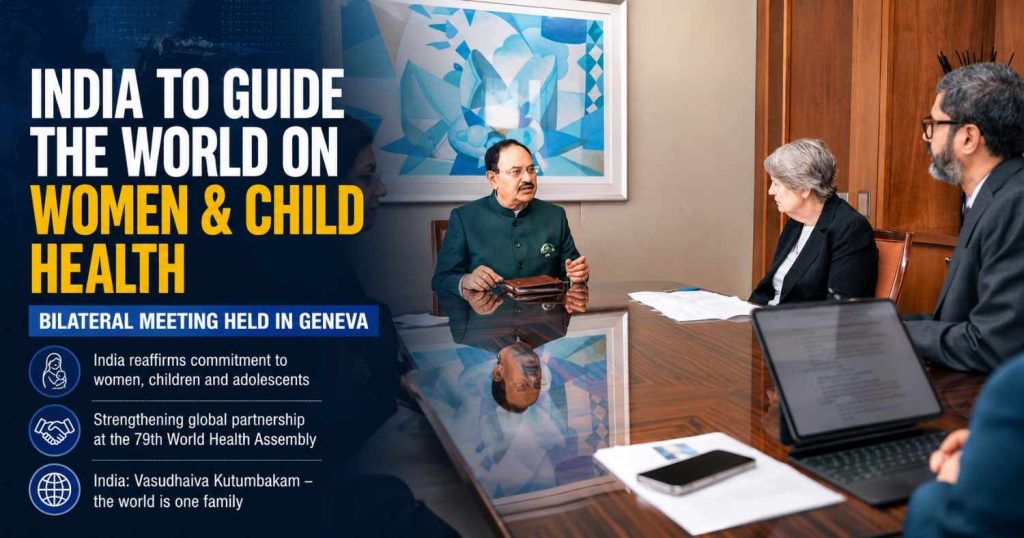
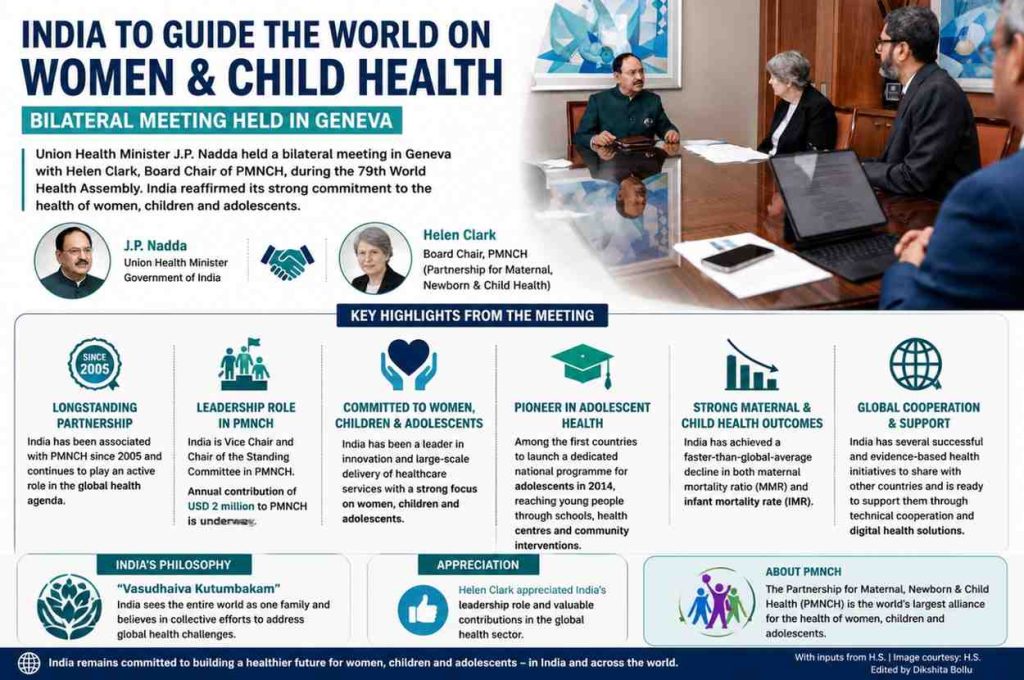
Union Health Minister J. P. Nadda held a bilateral meeting in Geneva with Helen Clark, Board Chair of the Partnership for Maternal, Newborn & Child Health (PMNCH), during the 79th World Health Assembly.
The discussions focused on strengthening global cooperation in maternal, newborn, child and adolescent health, while reaffirming India’s commitment to advancing healthcare access and innovation.
India Highlights Continued Commitment to PMNCH
During the meeting, Nadda said India has remained actively associated with PMNCH since 2005 and continues to contribute significantly to the global health agenda.
PMNCH is regarded as one of the world’s largest alliances dedicated to improving the health and well-being of women, children and adolescents.
The Health Minister noted that India currently plays an important leadership role within the organisation as Vice Chair and Chair of its Standing Committee.
He also informed the meeting that the process for continuing India’s annual financial contribution of USD 2 million to PMNCH is underway.
Focus on Women, Child and Adolescent Health
Speaking about India’s healthcare priorities, Nadda said the country has consistently focused on large-scale public health delivery and healthcare innovation.
“India has been a leader in innovation and large-scale delivery of healthcare services. We have always prioritised the health of women, children, and adolescents,” he said.
The minister highlighted that India was among the first countries to introduce a dedicated national programme for adolescent health in 2014. According to him, the initiative reaches young people through schools, healthcare centres and community-level interventions.
India’s Progress in Maternal and Infant Health
Nadda also pointed to India’s progress in reducing maternal and infant mortality rates.
He stated that India has achieved a faster-than-global-average decline in both maternal mortality and infant mortality indicators in recent years.
The minister added that several evidence-based healthcare initiatives developed in India could be shared with other countries facing similar public health challenges.
India, he said, is prepared to support nations through technical partnerships, digital health systems and knowledge-sharing initiatives.
“Vasudhaiva Kutumbakam” in Global Health Diplomacy
During the discussions, Nadda referred to the Indian principle of “Vasudhaiva Kutumbakam,” which translates to “the world is one family.”
He said the philosophy reflects India’s approach toward global health cooperation and collective action in addressing international healthcare challenges.
PMNCH Appreciates India’s Role
Helen Clark appreciated India’s contribution and leadership in the global health sector during the meeting.
Officials said the interaction further strengthened collaboration between India and PMNCH at a time when countries are increasingly focusing on public health preparedness, maternal healthcare and adolescent well-being.
Why the Meeting Matters
The bilateral meeting comes amid growing international discussions on equitable healthcare access, maternal health outcomes and digital public health systems.
India’s active participation at the World Health Assembly reflects its expanding role in shaping global healthcare policy, particularly in areas related to women’s health, child nutrition, vaccination and adolescent care.
With inputs from H.S.
Inputs and Image courtesy from Hindustan Samachar (H.S.)
Edited by Dikshita Bollu
Last Updated on: Wednesday, May 20, 2026 6:12 pm by Bollu Dikshitha | Published by: Bollu Dikshitha on Wednesday, May 20, 2026 6:12 pm | News Categories: News
About The Author